“He said it was temporary. A bridge loan, he called it. Just until things improved.”
She folded her hands on the table.
“He was very polite about it. Very apologetic. He said he wouldn’t ask except he had no other options.”
“Mom.”
My voice came out as a whisper.
“Tell me you didn’t.”
“I did.”
The kitchen felt very small suddenly. Very close.
“How much?”
“Thirty thousand dollars.”
I think I made a sound. Some kind of laugh or groan or something in between.
Thirty thousand dollars.
Almost a third of what she’d spent her entire life saving.
“Why didn’t you tell me?” I asked. “Three weeks. Mom, you waited three weeks.”
She looked at me steadily.
“He asked me not to. He said he would tell you himself when he had a plan. He said if I told you first, it would make things worse between you.”
She paused.
“I gave him two weeks. Then I gave him one more. He didn’t tell you.”
“So you’re telling me now?”
“I’m telling you now because he called again last week. He needs more.”
That night, I confronted David about the loans. He admitted to all of it. The thirty thousand from my mother, the credit lines in my name, the quarterly checks to his parents that were really coming from money my mother had saved her whole life.
He swore he’d pay it all back. He swore things would get better.
For a while, he even kept some of his promises.
He got a job at a brokerage firm. Not what he’d wanted, not the entrepreneurial dream he’d built his identity around, but a paycheck. He started coming home at reasonable hours. We paid off the credit line over the course of the next year, slowly and painfully, cutting back on everything we could cut back on. I took on extra projects at work. We stopped eating out. We canceled the vacation we’d been planning.
And through all of it, Constance and Robert kept their illusions.
David had told them he was transitioning to a new opportunity. That was how he phrased it, transitioning, and they’d accepted it without question. The quarterly checks kept coming, smaller now, but still coming. And I knew where the money was coming from because I’d seen the statements. Half of David’s new salary was going to maintain his parents’ belief that their son was a success.
The thing about Constance and Robert was that they never asked. They never called to see how David was doing. They never offered help. They just cashed the checks and continued their lives. The country club, the charity galas, the anniversary party they were planning for their fortieth.
The fortieth anniversary party became the thing we planned around, like a wedding or a funeral. Constance had been building up to it for two years. She’d mentioned it at every gathering, every dinner, every phone call. It was going to be at their country club, the one with the two-year wait list. They were inviting one hundred fifty people. There would be a live band and a plated dinner and speeches.
The save-the-dates went out in January.
Formal invitations in March.
I watched David open ours. Cream-colored card stock, embossed lettering, their names in flowing script.
My mother’s invitation never came.
I waited a week, then two. Finally, I asked David to call his mother about it.
“Maybe it got lost in the mail,” I said.
David’s face told me it hadn’t gotten lost in the mail.
“I’ll handle it,” he said.
He didn’t handle it.
Two more weeks passed. The party was a month away.
“David.”
“I know. I know. I’ll call her.”
“You said that two weeks ago.”
“She’s been busy with the planning.”
“Call her now while I’m standing here.”
He called. I listened to his side of the conversation. A lot of uh-huh and I see and no, I understand, and watched his face go through several expressions I couldn’t quite name. When he hung up, he wouldn’t look at me.
“Well?” I said.
“She said there’s a capacity issue. Fire codes. They had to cut the guest list.”
“My mother has been to every holiday at that house for four years.”
“I know.”
“She came to our wedding.”
“I know.”
“And she’s being cut because of fire codes.”
David finally met my eyes.
“She said it would be better this way. That your mother wouldn’t be comfortable at this kind of event.”
“This kind of event?”
“A formal dinner, wine pairings, speeches, she said.”
He stopped.
“What did she say?”
“She said your mother wouldn’t understand.”
The words hung in the air between us. The same words Constance had been saying, one way or another, since the day I met her.
Your mother wouldn’t understand.
As if understanding required money or breeding or a country club membership rather than basic human intelligence.
“I want to hear it from her,” I said.
“What?”
“I want to hear her say it to my mother’s face.”
David stared at me.
“You can’t be serious.”
“The anniversary dinner is next Saturday. We’re going to stop by their house before to drop off a gift, and my mother is coming with us.”
“That’s a terrible idea.”
“Maybe. But I’m done letting your mother insult mine behind closed doors. If she wants to exclude her, she can look her in the eye and explain why.”
David argued. He said it would cause a scene. He said his mother would never forgive him. He said I was being vindictive and unreasonable and this wasn’t the right time.
I didn’t argue back.
I just told him we were going and he could come with us or not.
His choice.
He came.
We pulled into Constance and Robert’s driveway at four o’clock on Saturday afternoon. The party started at six. We had plenty of time to drop off the gift and leave before the guests arrived.
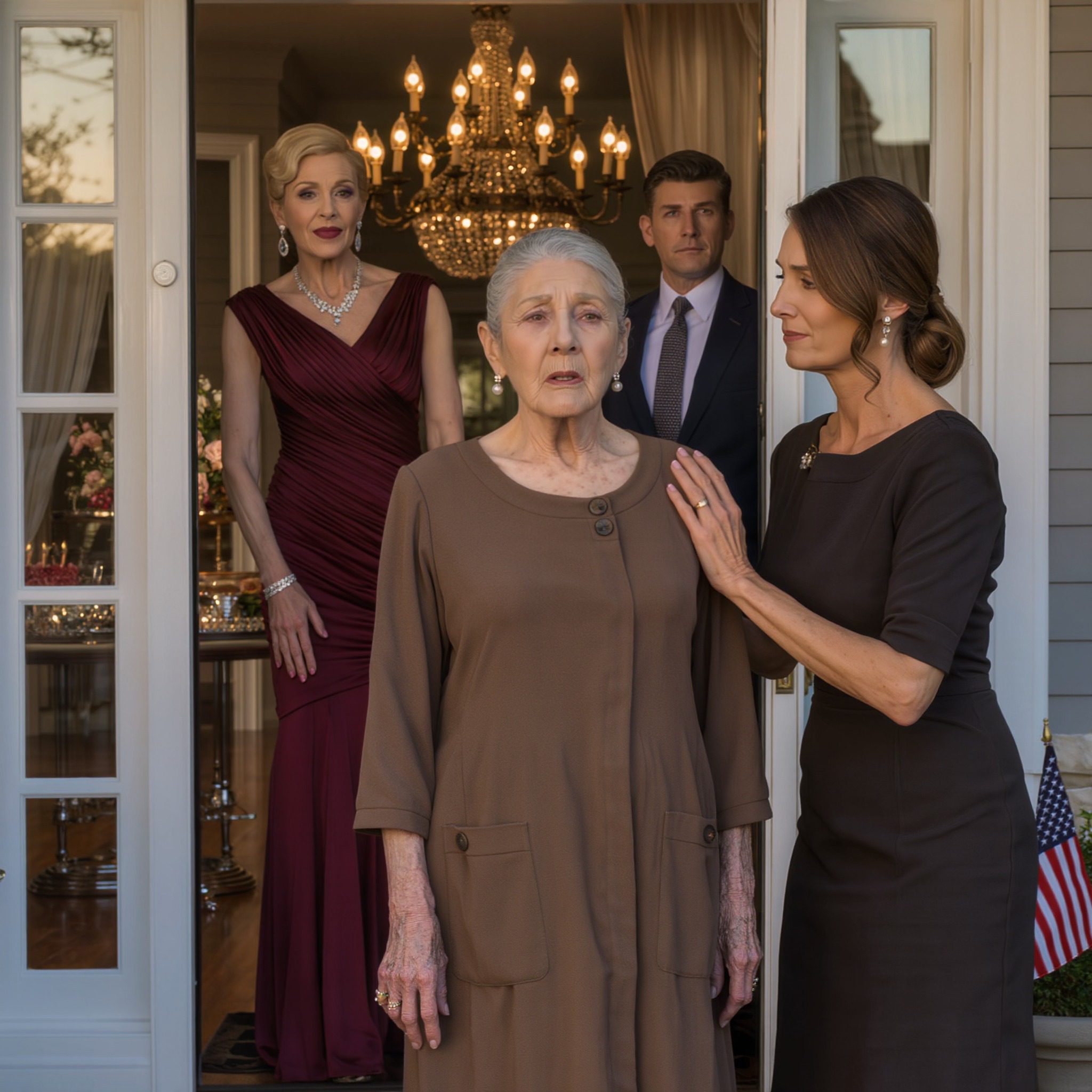
My mother sat in the back seat wearing her good dress, the brown one with pockets and her pearl earrings. She hadn’t asked why we were stopping by the house. She hadn’t asked anything. When I’d called to invite her, she’d just said, “What time should I be ready?”
Constance opened the door before we reached it. She was already in her party dress, a deep burgundy gown that probably cost more than my mother’s monthly mortgage had been, and her hair was swept up in an elaborate arrangement that must have taken hours.
“David, what a lovely surprise.”
Her eyes moved past him to me, then to my mother standing behind me.
Her smile froze.
“And Marta. I wasn’t expecting—”
“We brought a gift,” I said. “For the anniversary.”
“How thoughtful.”
Constance didn’t move from the doorway.
“You really didn’t have to.”
“Can we come in?”
A pause. Just a fraction too long.
“Of course. Of course. Robert is in the study. I’ll just—the caterers are everywhere. It’s absolute chaos.”
She stepped aside.
We walked into the foyer, the same foyer where I’d stood on my first visit all those years ago, trying to figure out what kind of people these were. The house smelled like flowers and expensive perfume. Through the archway to the living room, I could see staff members arranging centerpieces.
“The place looks beautiful,” David said.
“Thank you, darling. We’ve worked so hard on this.”
Constance’s eyes kept drifting to my mother, who stood quietly by the door, taking in the preparations with an expression I couldn’t read.
“Marta, can I get you something to drink? Water? Tea?”
“I’m fine.”
“Are you sure? It’s no trouble.”
“I said, I’m fine.”
Another pause.
Constance’s smile was starting to look painful.
“Well,” she said, “this is a nice surprise. I just wish you’d called ahead.”
“I would have—” She caught herself.
“Would have what?” I asked.
“Nothing.”
“Nothing at all?”
She laughed. A bright, artificial sound.
“I’m just so scattered today. Big events, you know, so much to think about.”
“My mother was wondering about her invitation,” I said. “It seems to have gotten lost in the mail.”
The smile dropped from Constance’s face just for a second, then it was back, but different now. Sharper.
“I see.”
She looked at David.
“David, didn’t you explain?”
“I explained.”
“Then I’m not sure what—”
“I’d like to hear it from you,” my mother said.
Everyone turned to look at her.
She stood very straight, her hands clasped in front of her, her face calm.
“I’d like to hear,” she continued, “why I’m not welcome at your party.”
Constance’s expression flickered through several emotions. Surprise, irritation, and something that might have been contempt before she covered it up.
“It’s not that you’re not welcome, Marta. It’s just, well, it’s a capacity issue. As I explained to David, we’ve had to make very difficult choices about the guest list, even some of our oldest friends.”
“That’s not what you told David.”
Constance’s eyes narrowed.
“I’m sorry?”
“You told him I wouldn’t be comfortable. That I wouldn’t understand.”
My mother’s voice was perfectly level.
“I’d like you to explain what that means.”
“I didn’t mean anything by it. I simply meant that—”
Constance gestured vaguely at the preparations around her.
“This is a certain kind of event. The wine pairings, the formal service, the dress code. It’s a lot to navigate if you’re not used to it.”
“I’ve attended formal dinners before.”
“I’m sure you have. Church functions and the like. But this is—”
She stopped herself, took a breath.
“Look, this is our fortieth anniversary. We’ve planned this for two years. Every detail matters, and I just think—”
She looked at my mother’s dress, at her sensible shoes, at her pearl earrings that had probably cost a fraction of the vase in the corner.
“I think everyone would be more comfortable if we kept this to people who understand the occasion.”
“The occasion?” my mother repeated.
“Yes. The occasion.”
It was as if something in Constance had finally slipped.
“It’s a sophisticated event.”
Her voice had taken on an edge now, the careful politeness falling away.
“I don’t expect you to understand the nuances. It’s not your fault. It’s just—you come from a different world, a different background, and that’s fine. That’s perfectly fine. But this is our celebration, and we have the right to share it with people who—”
She stopped, looked at me, then at David, then back at my mother.
“People who belong,” she finished.
The words fell into a silence so complete I could hear the caterers in the next room clinking glasses and discussing placement.
My mother stood there very still, her face unreadable.
“I see,” she said finally. “Thank you for explaining.”
She turned and walked out the front door.
I didn’t say anything to Constance. I didn’t need to. Her face was already rearranging itself, the defensive set of her jaw, the slight lift of her chin that said she’d done nothing wrong and wasn’t about to apologize for speaking the truth.
“Honestly,” she said to David. “I was only being honest.”
David opened his mouth, closed it again, looked at me, looked at the door my mother had walked through.
“We should go,” he said.
We walked out. Behind us, I heard Constance call something after David. Something about seeing him at six, about being on time for the speeches. But I wasn’t listening anymore.
My mother was already in the car, sitting in the back seat with her hands folded in her lap. Her face was still calm, perfectly composed. But when I got in beside her, I saw that her hands were trembling.
“Mom—”