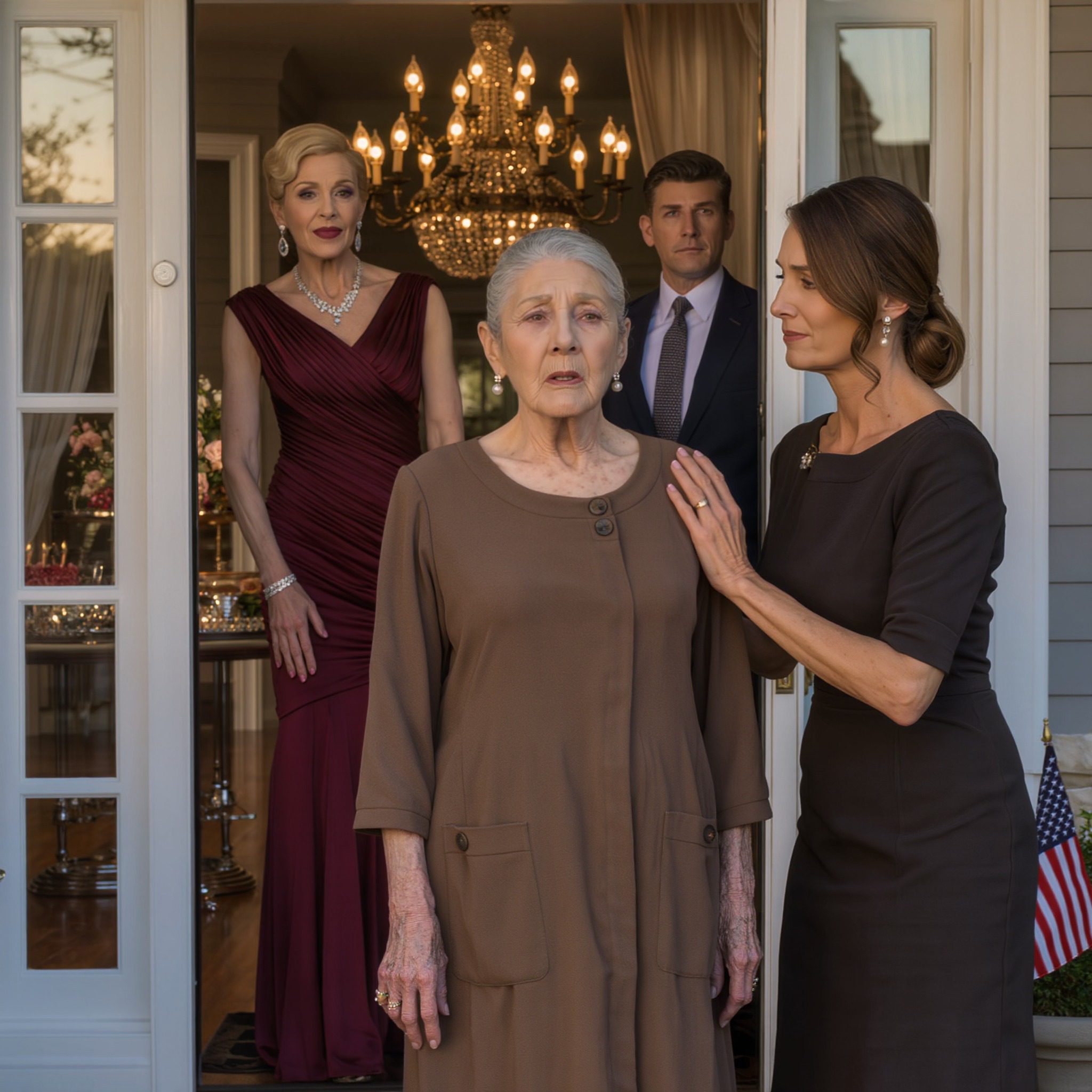
“Don’t,” she said quietly. “Not here.”
David got in the driver’s seat, started the car, pulled out of the driveway. The house, with its stone pillars and its circular turnaround and its caterers and its wine pairings, disappeared behind us.
We drove in silence for five minutes. Ten.
Finally, David said, “I’m sorry. I didn’t know she would—”
“Yes, you did,” I said.
He didn’t respond.
Another mile passed. My mother stared out the window, watching the expensive houses give way to slightly less expensive houses, then to the highway.
“David,” I said, “pull over.”
“What?”
“Pull over. I need to say something, and I don’t want you driving when I say it.”
He pulled into a gas station parking lot, turned off the engine. The silence was sudden and complete.
“The money stops,” I said. “Today. All of it.”
David turned to look at me.
“What are you talking about?”
“The dividends, the quarterly checks, whatever you’re still sending your parents. It stops tonight.”
“I can’t just—”
“My mother gave you thirty thousand dollars. She gave it to you so you could keep pretending to be something you’re not, and you took it, and then you used it to fund your parents’ lifestyle while they treated her like she wasn’t good enough to attend their party.”
My voice was shaking. I couldn’t stop it.
“That ends tonight.”
“You don’t understand what you’re asking.”
“I understand perfectly.”
“If I stop sending them money, they’ll know something’s wrong. They’ll start asking questions. My father will—”
“I don’t care what your father will do.”
“Please.”
David’s voice cracked.
“Please, just give me a few more months. Let me figure out how to—”
“No.”
“You’re being unreasonable.”
“I’m being unreasonable?”
I laughed.
“Your mother just told mine that she doesn’t belong at a party. A party funded with her own savings. And I’m being unreasonable?”
“That’s not—the money thing is separate.”
“You can’t just—”
“I can, and I am.”
“If you do this, you’ll destroy everything. My relationship with my parents, our finances, everything we’ve built.”
“What have we built, David? Tell me. Because from where I’m sitting, we’ve built a house of cards held together with my mother’s retirement fund.”
He stared at me.
In the back seat, my mother was silent, watching.
“This is about revenge,” David said. “You’re angry at my mother, so you’re punishing me.”
“I’m not punishing anyone. I’m stopping something that should have stopped a long time ago.”
“You don’t understand what it’s like to have parents who expect you to be—who need you to be—”
“Your parents don’t need you to be anything. They need your money. They need your success. They don’t care about you at all.”
“That’s not true.”
“Then where are they? Where were they when your business collapsed? Where were they when you were drowning in debt? They weren’t helping. They were cashing checks and planning parties and telling themselves that their son was a success because that’s all they care about.”
“Stop it.”
“They care about what you can give them. That’s it. That’s all. And I’m done letting my mother pay for their delusions.”
The parking lot was empty except for us. A truck pulled up to the gas pumps and someone got out and life continued around us as if nothing had happened.
He looked at me for a long moment.
Then he turned forward, started the car, and pulled back onto the highway.
We drove the rest of the way in silence.
The months that followed were exactly what I’d expected.
David tried to negotiate. He tried to find other sources of funding, friends, colleagues, anyone who might give him a loan to keep up the payments to his parents. No one would. He tried to explain to his parents that the dividends would be delayed, just temporarily, but Constance called him three times a week, asking when the money would arrive.
By October, the checks had stopped entirely.
By November, Constance and Robert were calling David in a panic. Their credit card had been declined at the country club. The trip to Italy they’d been planning had to be canceled. They were three months behind on their country club membership fees.
David relayed all of this to me in short, tense conversations. He blamed me. He said I’d ruined his relationship with his parents. He said I didn’t understand what I’d done.
I moved out in December.
My mother helped me pack. We loaded boxes into her car and drove them to a small apartment across town. And she didn’t say anything about David or his parents or any of it. She just carried boxes and made sure I ate dinner.
The divorce papers were filed in January.
I signed the final papers on a Tuesday in March, almost two years after that afternoon at the gas station. The process had dragged on. David contested things, then stopped contesting them, then contested them again, but eventually it was done.
We sold the house at a loss and split the remaining debt. I kept my apartment. He moved somewhere I didn’t know and didn’t ask about.
His parents, from what I gathered through mutual acquaintances, had to downsize. The house with the stone pillars and the circular driveway was sold. They moved to a condo somewhere, and their country club membership lapsed.
I didn’t go looking for details.
I didn’t need to.
A year after the divorce was finalized, I was at my mother’s house helping her plant tomatoes. It was a Saturday in May, warm enough to work outside without a jacket, cool enough that the work didn’t feel punishing. My mother had been talking about expanding her garden for months, and I’d finally found the time to help.
We worked side by side in the dirt, digging holes and placing seedlings and patting the soil down around them. The plastic deer were still in the neighbors’ yards. The driveway had been repaved since the last time I noticed, smooth new asphalt where the crack used to be.
“You’re getting better at this,” my mother said.
“I had a good teacher.”
She made a sound that might have been a laugh.
We kept working. When the last seedling was in the ground, we sat on the back steps drinking lemonade. The sun was starting to go golden the way it does in late spring, when the days are getting longer. A neighbor’s dog barked once somewhere far away and went silent.
My mother turned her glass in her hands.
“Are you happy?” she asked.
I thought about it. Really thought.
“I think so. Getting there, anyway.”
She nodded. Didn’t ask anything else.
We sat there for a while longer, watching the shadows lengthen across the garden.
“I’ve been thinking,” she said finally, “about putting in peppers next year over by the fence. That’s a good spot. Gets afternoon sun.”
“That’s what I thought.”
She stood up, brushed dirt from her knees.
“Come on. I made soup.”
I followed her inside. The kitchen smelled like onions and bay leaves and something else, something warm and familiar that I’d never been able to name, but always associated with this house, with her. She ladled soup into two bowls, slid mine across the table.
We ate without talking, the way we often did, not because we had nothing to say, but because we didn’t need to say it.
When we finished, she gathered the bowls and took them to the sink.
“Same time next weekend?” she asked.
“I’ll be here.”
“Good.”
She turned on the water.
“Bring gloves this time. Your hands look terrible.”
I looked at my hands. Dirt under my fingernails, a scrape on one knuckle from the garden stake.
I laughed.
Outside, the last of the daylight was fading, turning the garden soft and golden. The tomato seedlings we’d planted stood in their neat rows, small and fragile and full of possibility.
I picked up my keys from the counter.
“Same time next week,” I said.
My mother waved without turning around, both hands still in the sink.
I walked to my car. The air smelled like cut grass and soil and the first hints of summer. Somewhere down the street, kids were playing, their voices rising and falling in the twilight.
I got in the car, started the engine. In the rearview mirror, I could see my mother’s house, small and solid, and paid for every brick and shingle. The lights were on in the kitchen. She was probably still at the sink, doing dishes the same way she’d done them for forty years.
I pulled out of the driveway and headed home