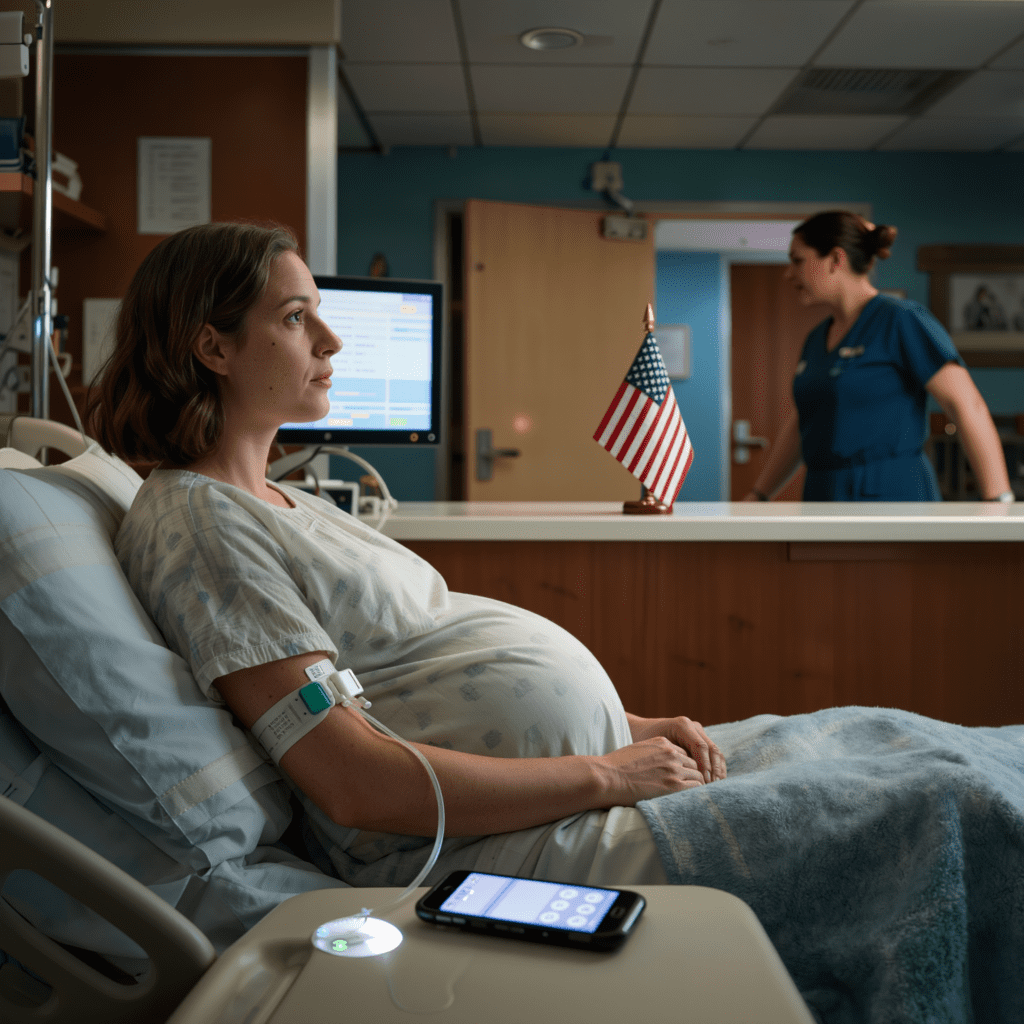
Sarah immediately understood my predicament and, after talking quickly with the dispatcher, arranged for a special taxi that could take me to the hospital faster than the ambulance they said might be delayed. She stayed by my side, supporting my arm as we waited, talking softly to keep me calm while I breathed through the pain. Gratitude and relief washed over me, and tears streamed down my face.
Soon after, thanks to Sarah’s help, I safely arrived at the hospital’s maternity ward. As nurses wheeled me toward a room, Sarah walked alongside, holding my hand.
On the way, as the fluorescent lights passed overhead, I made a silent vow.
I will make him pay for this.
Even as the labor pains intensified, Sarah kept her hand wrapped around mine. After I was settled in the room, she called my parents, who lived ten minutes away on the other side of town. They arrived not long after, their faces tight with worry.
“There’s something I want to discuss,” Sarah whispered to them, and the three of them stepped out into the hallway together.
As the contractions sharpened, my smartphone vibrated from a corner of the room. I grimaced, breathing through another wave.
“Who is it?” I asked.
My parents checked the screen, their expressions darkening.
“It’s David,” my father said, displeasure clear in his voice.
Despite everything, I took the call. As soon as I answered, I heard David’s panicked voice.
“Help me—”
But I was in no state, or mood, to listen to him. I ended the call immediately, and my parents turned off the phone and set it facedown. Even after that, messages from him continued to pour in, but I no longer saw them.
As the labor intensified, the nurses finally moved me into the delivery room. Time blurred into a painful, gasping haze. After what felt like an eternity, the pain crashed one last time and then broke, and I finally heard the high, clear cries of my baby.
Exhausted, I let my head sink back against the pillow. Through bleary eyes, I saw my parents and Sarah standing behind the glass with warm smiles. Relief flooded me, and I closed my eyes, letting sleep take me.
When I woke up a few hours later, I was lying in a quiet hospital room. The afternoon light filtered through half-closed blinds, making soft stripes on the walls. My parents were sitting beside my bed, their faces filled with concern and tenderness.
“Are you okay?” my mother asked gently.
Still feeling the weight of exhaustion, I couldn’t fully sit up. My father’s eyes were shiny, and my mother softly reassured him that the postpartum period could be exhausting.
Witnessing that heartwarming scene—my parents here, steady and present, after everything—I felt a small smile form on my lips.
“How’s the baby?” I asked.
My parents told me that the baby was undergoing some routine tests in the nursery but would be brought back soon. I glanced around, noticing that Sarah wasn’t in the room.
“Sarah left a little while ago,” my mother said, as if reading my thoughts. “She said she’d be back soon.”
Thinking of how differently this day could have turned out if Sarah hadn’t been there, gratitude settled heavily in my chest. I promised my parents that after I was discharged, we would visit Sarah and thank her properly.
Later, I turned on my phone to inform my friends about the birth. The screen lit up with an overwhelming number of missed calls, most of them from David. For a moment, I just stared at the list scrolling down and down. But I felt no hope or expectation from his calls anymore. I closed the notifications without hesitation.
One of my close friends came by the hospital to congratulate me. She brought flowers and balloons and hugged me carefully.
“I’m so happy for you,” she said. “Your baby is beautiful.”
As she rejoiced and offered genuine congratulations, I found myself opening up and telling her about everything that had happened with David—the fight over the beer, the ruined dinners, leaving me in the hallway, insisting on the family trip, my water breaking, and him driving away.
Hearing the story, she gasped in shock and anger, her hands balling into fists.
“I swear, I’d love to punish him a little for this,” she said, half-joking, half-serious. Then she softened. “But right now, your health and rest are the most important things. Focus on you and your baby first.”
We talked for a while longer, and then she left, promising to check in again.
My parents, already fully informed by Sarah about the entire episode, looked at me seriously.
“What are you planning to do next?” they asked.
I took a breath and shared my thoughts about my relationship with David.
“I’m considering divorce,” I said.
They listened silently and then nodded. They respected my decision and promised their full support. When I was discharged, I planned to stay at my parents’ home. They had already prepared a small room for me and the baby, complete with a crib and a mobile of little stars.
Meanwhile, it seemed David had tried to visit the hospital, but because I had already informed the staff that I didn’t wish to see him, he was not allowed into my room. The nurses and doctors, aware of my situation, were quietly protective.
The next day, Sarah came to my hospital room holding a fruit basket wrapped in cellophane and tied with a ribbon.
“Sarah, you came,” I said, genuinely delighted.
“You seem to be recovering well,” she said, setting the basket on the side table. “But remember not to overexert yourself. Postpartum fatigue can be pretty intense.”
Her calm voice comforted me, and I let out a long sigh of relief.
“Sarah, thank you so much for helping me,” I said, bowing my head. “I don’t know what would have happened if you hadn’t been there.”
She laughed softly. “What’s most important is that both you and the baby are healthy,” she said. “That’s all I care about. I just wanted to lend a hand where I could.”
“Regardless, I’m forever grateful,” I insisted. “Once things settle down, I’ll come over with my parents and thank you properly.”
Sarah smiled warmly. “You know, I’ve talked to my husband about what happened,” she added. “He was… quite furious.”
From her tone, I could imagine just how angry he’d been.
“Sarah, I’m truly sorry for dragging you into this mess,” I said.
“Don’t worry about it,” she replied. “Remember who you owe for being able to work at your current company.”
There was a new firmness in her voice that I’d never heard before.
Sarah was actually the wife of the CEO at the company where David worked. When we first moved into this residential neighborhood outside Denver, I had no idea. We only met as neighbors: in the supermarket aisles, at the local coffee shop, passing each other at the convenience store. Over time, we began to chat more and more. Eventually, we started enjoying tea together at her house, and during those afternoons I learned what her husband did and how respected he was.
David, however, was completely unaware of this. He hadn’t even come with me when we did our initial neighborhood greetings, and he didn’t like interacting with neighbors. Sarah had once told me gently, “I don’t want to cause any trouble at his workplace, so please don’t tell your husband about us,” and I had respected that request.
Knowing that I was pregnant and still being forced to endure David’s unreasonable behavior, Sarah had suggested several times, “Should I talk to my husband about this?” But I had always declined, not wanting to cause problems at David’s job.
With this latest incident, though, maybe even Sarah had reached her limit. That was probably why David kept calling her, too, after everything blew up.
“I really can’t thank you enough for everything,” I said, my voice catching.
Sarah’s strong words and unwavering support made me realize how fortunate I was to have someone willing to go to such lengths for me. I felt tears well up again. Seeing my reaction, she gave me another warm smile.
“Lisa, you’re a dear friend to me,” she said. “I can’t just stand by and watch when something like this happens to a friend.”
Our conversation was filled with genuine smiles and small moments of silence. However, my phone still buzzed periodically with notifications. Despite the barrage of messages from David, I consciously ignored them.
Thinking about divorce made my mind feel clearer. All I wanted now was to think about how to live my life with my baby, safely and peacefully.
A day or two before I was scheduled to leave the hospital, another close friend visited my room, this time holding her smartphone instead of flowers.
“I want you to see this,” she said, handing it to me.
On the screen was a post that had become a major topic on a certain social media platform. The view count ticked upward in real time.
“What is this?” I asked.
“I posted about what your husband did,” she admitted. “And then something unexpected happened.”
She had a significant influence online, with a large number of followers. One day, she received a reply to one of her posts from a follower who, by chance, had captured a video of the exact scene where I was yelled at by my husband and left beside the car in our driveway. The follower, wanting to protect my privacy, blurred my face in the video. With my friend’s permission, they shared it online.
The video spread like wildfire. The suburban houses, the Colorado plates on the car, the sound of David’s angry voice—it all became viral. Internet users dug deeper and quickly discovered personal details about David and even his company. Right now, according to my friend, he seemed to be under a barrage of criticism online.
“I had no idea it had escalated to this level,” I murmured, stunned.
“Well, they brought it upon themselves, didn’t they?” my friend said gently. “Your husband’s actions, and their consequences, are all the result of choices he made.”
Furthermore, when one of David’s friends confronted him about the incident, David reportedly tried to excuse himself.
“I had a prior travel commitment with my parents that day, so I had no choice,” he’d said.
Because of that statement, not only David but also his parents began to face criticism online. The story spread even in the vicinity of my in-laws’ home, and various topics related to them started circulating on social media—whispers about how they raised their son, about what kind of people would let this happen.
Suddenly my phone started ringing again. When I checked the screen, it was a call from my mother-in-law.
My friend, peeking at the display with interest, said, “Why don’t you pick up and give her a piece of your mind?”
But I was so fed up that I couldn’t think of anything I wanted to say. Instead, I let the call ring out and then silenced it. Before long, the missed call log was filled with the names of my husband, father-in-law, and mother-in-law.
Ever since the incident had been highlighted on social media, even the hospital staff seemed to be aware of my situation. Nurses and doctors offered quiet, genuine support—an extra smile, a reassuring hand on my shoulder. Whether my husband or in-laws came to the hospital or called multiple times, the staff did not allow them to make contact with me.
As my discharge date approached, I had one pressing worry: whether David and his parents might be lurking somewhere outside the hospital, waiting to ambush me as I left.
My parents reassured me over and over. “You have nothing to worry about,” they said. “We won’t let anything happen.”
But the thought of my precious baby being in danger left me anxious.
That concern was quickly dispelled.
On the day of my discharge, as my parents helped me with my belongings and the nurse wheeled the car seat out, I heard David’s voice echo down the hallway.
“Lisa!” he shouted.
My in-laws’ voices followed, loud and insistent. Just as my heart started to race, men in black suits appeared seemingly out of nowhere, moving with calm coordination. They surrounded me and my parents, forming a protective barrier as we walked toward the hospital’s front entrance.
As I tried to understand what was happening, one of the men stepped closer, opened the door of a sleek black car, and said in a gentle tone, “Don’t worry. We’re here on sir’s request to protect you, ma’am.”
It seemed my parents already knew about this. My mother smiled.
“Didn’t I tell you there was nothing to worry about?” she said quietly.
Believing her, I felt relief wash through me. I climbed into the car with my baby in my arms, my parents following. All the while, David and my in-laws, overwhelmed by the imposing presence of the bodyguards, couldn’t come any closer than the edge of the sidewalk. The hospital’s automatic doors slid closed behind us, cutting off their voices.
As the car pulled away from the curb, I couldn’t find the words to express how grateful I was for Sarah and her husband. The only thing occupying my mind was how to repay their kindness.
My parents felt the same.
“We have to find a way to show our gratitude to Sarah,” they said in unison.