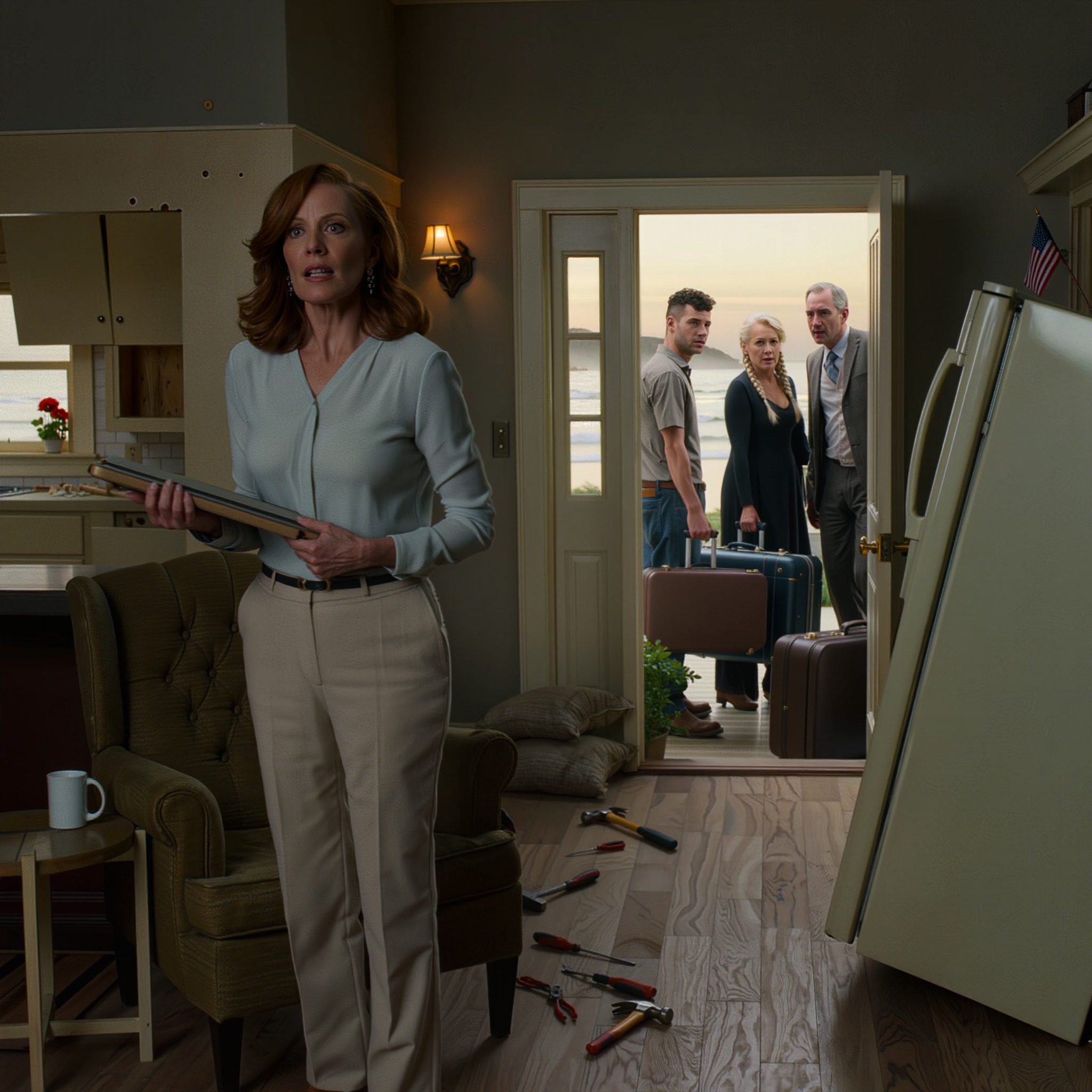
When I arrived at my beach house that Friday afternoon, Khloe was already on the deck giving orders to three workers as if she owned the place. She didn’t greet me. She didn’t even turn her head when the car stopped in front of the entrance. She just raised her hand, pointing toward the kitchen, and shouted something about the tile needing to arrive before Monday.
I felt a chill run down my spine that had nothing to do with the sea breeze. I got out of the car slowly, watching. The front door was wide open. There were bags of cement stacked next to my pots of geraniums, the ones I planted five years ago with my own hands. The sound of a drill pierced the air from somewhere inside the house.
My house. The house I bought after forty years of working double shifts as a nurse at General Hospital. The house I paid for with my sweat after my husband died and left me with nothing but debts and broken promises.
Khloe finally saw me. She smiled— that smile that always made me nervous. Too wide. Too perfect.
“Olga, I’m so glad you’re here,” she said, as if she were doing me a favor by acknowledging my presence on my own property. “Matthew is inside supervising the kitchen. You’ll see. It’s going to be beautiful.”
I didn’t answer. I walked toward the entrance, feeling my seventy-one-year-old legs protest with every step. I had driven four hours from the city specifically to rest, to listen to the waves, to be alone with my thoughts and my memories. I had dreamed about this week for months, planned every detail—morning walks on the beach, the books I would read in the hammock, the silence I so desperately needed after an exhausting year.
What I found inside took my breath away.
The kitchen no longer existed. Or rather, it half existed. The cabinets I installed three years ago had been torn from the walls. The tile floor I had chosen so carefully was covered in dust and debris. The walls showed huge holes where the paintings from my Thursday afternoon art classes once hung. The refrigerator was in the middle of the living room, unplugged, its door ajar. The smell of dampness and fresh cement hit me like a slap.
“What is this?” My voice came out calmer than I expected, almost a whisper.
Matthew appeared from the hallway. My son—forty-five years old and still with that look of a child, expecting Mom to fix everything. Except now there was something different in his eyes. Something hard.
“Mom, it’s a surprise.” He wiped his hands on his pants, leaving gray dust marks. “We’re remodeling. Khloe and I decided it’s time to update everything. This kitchen was just too old.”
“You decided,” I repeated. The word hung in the air between us.
“Yes. And not just the kitchen.” He walked toward the stairs, and I followed him, feeling my heart begin to beat faster. We went up, each step heavier than the last.
When we reached the second floor and he opened the door to the master bedroom—my room—I had to hold on to the doorframe to keep from falling. The bed was gone. The armoire that belonged to my grandmother, that carved wooden heirloom that had survived three generations, had been moved who knows where. The walls were half painted a mint green color I would have never chosen. There were tools everywhere, wires hanging from the ceiling, and a penetrating smell of fresh paint that made me dizzy.
“Where is my bed? Where are my things?”
“We put them in the small room at the end of the hall temporarily.” Matthew wasn’t even looking at me. He was checking something on his phone, typing a message. “We just… we need this master bedroom for something important.”
“For what?” The question came out with more force than I intended.
That’s when he said it. When he spoke the words that would change everything.
“Khloe and I are going to move in here permanently—with Gloria, her mom, and her dad. They need a better place, and this house is big enough. We’re making the rooms bigger, modernizing everything. It will be perfect for everyone.”
I stood motionless, paralyzed. The words bounced around in my head but couldn’t form a coherent thought.
Move in permanently. With Khloe’s parents.
“This is my house, Matthew.”
“I know, Mom, but it’s also family property. It’s time you shared it. You have your apartment in the city. You don’t need two properties. We do.” He said it like it was obvious, like the problem was my failure to understand. “Khloe is tired of the city noise. And Gloria deserves to live her last years by the sea. She’s seventy-three, two years older than you. Don’t you think she deserves it?”
There was so much twisted logic in his words that for a moment he almost convinced me. Almost.
Until I saw the look on his face—determination mixed with something that looked dangerously like indifference. He wasn’t asking my permission. He was informing me of a decision already made.
“You didn’t consult me because you knew I’d say no,” he went on. “You always say no when it comes to helping the family. You’ve always been like that, Mom. Selfish with your things.”
The word cut through me like a knife.
Selfish.
Me who worked until my hands trembled with exhaustion. Me who paid for his entire college while he changed his major three times. Me who lent him money for the down payment on his car two years ago and he never paid me back.
Selfish.
I went down the stairs slowly. Each step was a conscious effort not to tremble, not to let myself fall. Khloe was still outside now, on the phone, laughing. I heard her say something about finally having the space we always wanted, and the old woman will just have to get used to it.
I went into what was left of the living room. I sat in the only armchair they hadn’t moved, that olive-green armchair where my husband used to fall asleep on Sunday afternoons watching football. I closed my eyes. I breathed one, two, three times deep.
When I opened them, my gaze fell on my purse. On the vital documents folder I always carried with me—the folder where I kept all the important papers: deeds, wills, contracts, legal powers of attorney, everything perfectly organized and updated. Because after forty years in the health care system, I learned that life can change in a second, and it’s better to be prepared.
I took out my phone and looked for a name in my contacts.
Gregory—my lawyer for fifteen years. The man who helped me with all the paperwork when I bought this house, when I updated my will, when I made sure every property was solely in my name after discovering the debts my husband hid for years.
I dialed. Three rings. Four.
“Olga, what a pleasure to hear from you.”
“How are you, Gregory? I need you to come to the beach house tomorrow morning very early. Bring the property deeds and the will. All of it.”
There was a pause. Gregory knew me well. He knew that if I called him on a Friday afternoon asking for something urgent, it was because the situation demanded it.
“Did something happen?” he asked.
“Yes,” I replied, looking out at the deck where Khloe was still laughing, oblivious to what was about to happen. “But it’s not going to happen anymore.”
I hung up. I put the phone away. I sat there in my armchair, surrounded by the disaster they had made of my refuge—my sanctuary, the place I had built with decades of effort.
I didn’t cry. I didn’t scream. I didn’t confront anyone that night. I just waited, because I had learned something in seventy-one years of life: revenge served hot burns the one who serves it. But revenge served with absolute cold, with surgical precision—that kind destroys without leaving a trace of the one who delivered it.
Matthew came down an hour later. He told me he had prepared the small room for me, that my clothes were in boxes because they needed the master closet for Khloe’s and Gloria’s things. He handed me a new key.
“It’s for the room at the end of the hall, Mom. We put a lock on it so you can have privacy.”
I took the key without saying anything and went up. The back room was barely nine feet by nine. A single bed pushed against the wall. My things in cardboard boxes. A small window that looked out onto the parking area, not the sea.
I lay down on the bed fully dressed and stared at the ceiling. I heard the waves in the distance, that sound that always calmed me. But that night it only reminded me of everything they were trying to take from me.
I closed my eyes and thought about tomorrow—about Gregory arriving at 6:00 in the morning, about the documents I would sign, about the calls I would make. For the first time in hours, I felt something close to peace.
This was just the beginning.
I woke up at five in the morning, not because I wanted to, but because my body had been accustomed to hospital shifts for decades. Outside, it was still dark. I could hear the sea, that constant murmur that used to calm me, now sounding like a silent witness to everything I had lost in less than twenty-four hours.
I got up slowly. My knees protested as always. Seventy-one years. You don’t forgive. It doesn’t matter how much yoga you do or how many vitamins you take.
I opened one of the cardboard boxes where they had thrown my clothes. I found some gray pants and a white blouse. I dressed in silence, listening. The house was completely quiet. Matthew and Khloe were sleeping in the first-floor guest room, the one I always reserved for important visitors. Now they had taken it as if it were their own.
I went down the stairs, avoiding the third step, the one that always creaked—a habit from my years as a night nurse, when I learned to move without making a sound so as not to wake the patients. I reached the living room.
The disaster was still there, of course: the debris, the dust, the refrigerator still in the middle of everything. But there was something different.
On the dining room table—the wooden table I bought at an antique market ten years ago—there were papers. Lots of papers.
I got closer. They were quotes, estimates from contractors, interior designers, furniture stores. I reviewed the numbers and felt the air leave my lungs.
$120,000.
That was the total cost of the remodel they had planned. $120,000 they planned to spend on my house without asking me, without my authorization, without my signature.
There was something else. A red folder under the quotes.
I opened it. Inside, I found a legal document half-filled: a power of attorney. My name was written at the top as the grantor and Matthew’s name as the appointee. The sections described permissions to sell, remodel, mortgage, and manage properties. The date was blank. The signature line was, too.
I stared at that paper for long minutes. Then I understood the full plan.
They didn’t just want to move into my house. They wanted me to sign a document that would give them total control over all my properties. And they probably expected me to do it without reading—trusting my son blindly, as I had always done.
I took out my phone and took pictures: of the estimates, of the power of attorney, of every single page. Then I put everything back exactly as I had found it.
At 5:40, Gregory arrived. I heard his truck park outside. I went out before he could knock on the door. The sky was beginning to lighten with orange and pink hues. It was cold. I wrapped myself in the sweater I had brought.
“Good morning, Olga.”
Gregory was sixty years old, perfectly combed gray hair and that serious expression of someone who has seen too many families destroyed by money. He was carrying a brown leather briefcase.
“What happened?”
I told him everything—every detail. As I spoke, he opened his briefcase and took out documents. The same documents I had signed years ago when I decided that no one would ever control my life or my assets again.
“Let me see if I understand this correctly,” Gregory said when I finished. “Your son and his wife began remodeling work on your property without your written consent. They are planning to move in permanently without your authorization, and you found a power of attorney they expect you to sign.”
“That’s right.”
“Do you know what this means legally?”
“You tell me.”
“It means they have committed trespassing, property damage without the owner’s authorization, and possibly attempted fraud if they plan to have you sign that power of attorney under false pretenses.”
He took more papers out of his briefcase. “I have the deeds right here. Everything is solely in your name. Neither Matthew nor anyone else has any legal right to this house. I can draft an immediate eviction order. They have to be out in forty-eight hours.”
“Do it.”
Gregory hesitated. “Olga. Think about it. He’s your son.”
“I’ve already thought about it all night,” I said, “during every minute I spent locked in that tiny room while they planned to steal what took me forty years to build. My voice didn’t tremble. “Do it, Gregory. Now.”
He nodded and took his laptop out of his briefcase. For the next hour, as the sun finished rising and the house remained silent, Gregory drafted the documents: eviction order, complaint for damages to private property, request for an injunction to stop the work—everything with the official seal, with the laws cited, with the deadlines set.
“I need a process server to deliver this personally,” I said. “Today. This morning.”
“I can make the calls,” Gregory replied. “I have contacts at the courthouse. If I explain that it’s urgent, they can come before noon.”
“No,” I said. “I want it to be at 6:00 in the morning tomorrow. Saturday.”
Gregory looked at me with that expression he reserved for his most determined clients.
“You want them to be woken up with the news exactly like they ruined my vacation by arriving unannounced and destroying my house. I want them to feel that same invasion, that same lack of control.”
“It can be done,” he said slowly. “But Olga, when this happens, there’s no going back. Family relationships—”
“There’s no family relationship left to save,” I interrupted. “That ended when my son called me selfish for not wanting to give away what cost me a lifetime to earn. When his wife spoke about me as if I were a burden. When they planned to make me sign documents to take away control of my properties.”
Gregory was silent for a moment. Then he closed his laptop.
“All right. I’ll make the calls. The officers will be here tomorrow at 6:00 sharp. I’m also going to notify the construction company to stop all work immediately or face legal charges, and I’m going to request an inspection of the damages to calculate the compensation.”
Matthew will have to pay you.
Compensation for the material damages—the destroyed cabinets, the damaged floor, the walls. Everything has a cost. Legally, he is responsible for paying for it.
Something stirred inside me. It wasn’t joy. It wasn’t satisfaction. It was simply the certainty that I was doing the right thing. That after a lifetime of putting myself at the end of the line, after years of sacrificing for others, I was finally choosing myself.
“Do it all,” I said.
Gregory left at 7:30. I asked him to use the side entrance so Matthew and Khloe wouldn’t see him. I didn’t want them to suspect anything yet.
I went back into the house, went up to the small room, sat on the bed, and waited.
At 8:00, I heard movement downstairs—footsteps, voices. Matthew on the phone with someone, probably the workers, giving them instructions for the day. Khloe laughing at something. The sound of the coffee maker.
I went down at 8:30. When I entered the makeshift kitchen they had set up in a corner of the living room, Khloe was pouring coffee into one of my favorite mugs—the white ceramic one with yellow flowers I bought on my last trip to Asheville.
“Good morning, Olga. Did you sleep well?” she asked without really looking at me, focused on her phone.
“Perfectly,” I lied.
Matthew walked in. He was wearing a wrinkled shirt and the expression of someone who was fast asleep five minutes ago.
“Mom, I need to talk to you about something important.”
“Tell me.”
“We need you to sign some papers,” he said. “It’s to speed up the work so the contractors can make changes without having to consult you on every detail. It’s just a formality, but legally they need your authorization as the owner.”
There it was—the moment I had anticipated.
I walked over to the table where the papers from last night still sat. I picked up the red folder and opened it. I took out the blank power of attorney.
“Are you talking about this?”
Matthew’s expression changed just for a second, but I saw it—surprise, discomfort. Then he tried to smile.
“Yes. Exactly. It’s just to make everything easier. Nothing to worry about.”
“Nothing to worry about.” I held the paper in front of him. “This isn’t an authorization for work, Matthew. This is a full power of attorney that would give you control over all my properties—to sell, mortgage, manage everything.”
“Mom, it’s not like that. The lawyer said it was necessary to—”
“What lawyer?”
Silence.
Khloe stopped looking at her phone. Matthew froze.
“There is no lawyer, is there?” My voice remained calm—dangerously calm. “You drafted this yourselves. You downloaded a template from the internet and thought I would sign without reading because I trust you.”
“It’s not like that,” he insisted.
