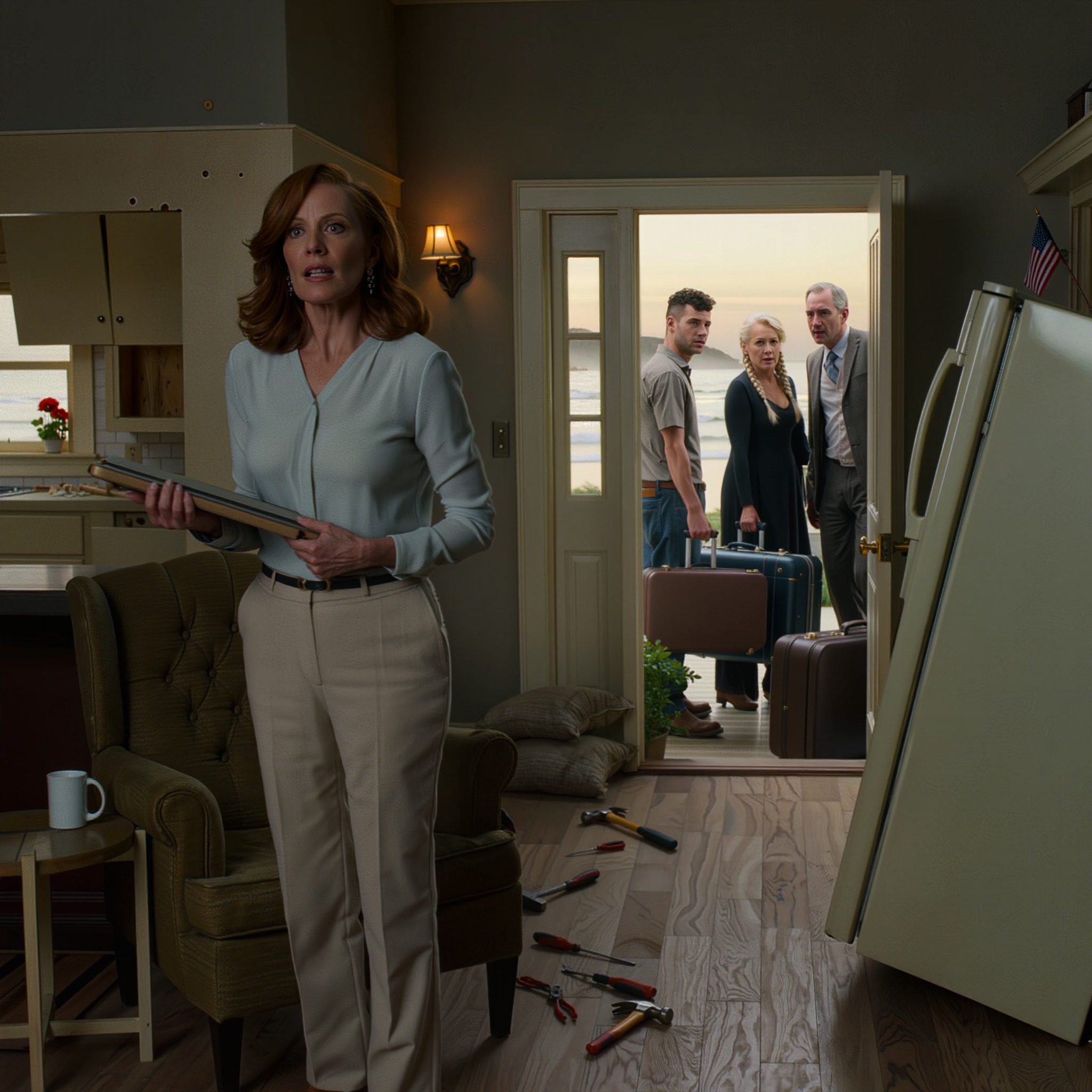
“I’m not signing anything. And I want the work to stop today.”
“Mom, we’ve already invested money in this,” Matthew said, his voice rising. “We’ve already paid deposits.”
“With what money, Matthew?” I asked. “Tell me. With what money did you pay for $120,000 in renovations?”
His face turned pale. “How do you know that amount?”
“Because unlike you, I do read the papers that are in my own house.”
Khloe intervened, her voice losing all its sweetness. “Olga, don’t be so dramatic. We just want to improve the house. Make it more modern, more livable. When Gloria and my dad move in, they’re going to need comforts.”
“No one is moving in here,” I said.
“That’s not for you to decide alone,” Khloe snapped.
“Yes, it is. It’s my house.”
Khloe slammed the mug down on the table. “You are incredibly selfish. You have two properties and you refuse to share one. Gloria is older than you. She has health problems and she deserves to live in a decent place.”
“Then you buy a house for Gloria.”
“We can’t afford a house on the beach,” she shot back. “Not all of us were lucky enough to get properties when they were cheap.”
“It wasn’t luck. It was work,” I said. “Forty years of work.”
I turned and went up the stairs. I could hear them talking downstairs, their voices rising, arguing about what to do now, about how to convince me.
I didn’t care. I went into the small room, locked the door, sat on the bed, and looked at the ceiling.
Tomorrow at 6:00 in the morning, everything would change. And for the first time in a long time, I was going to be the one in control of that change.
The rest of Friday passed in a tension so thick you could cut it with a knife. Matthew and Khloe spoke in low voices whenever I appeared. The workers arrived at 10:00 in the morning, and Khloe had to tell them to wait, that there was a small problem with the permits. The men stood outside smoking, looking at their phones, getting paid by the hour to do nothing.
I stayed in my room almost all day. I read—or at least I tried to. The words blurred on the page. My mind was elsewhere, going over every detail of what was to come. Gregory had sent me a text confirming everything: the process servers would arrive at exactly 6:00 in the morning on Saturday. They would bring the eviction order, the cease-and-desist for the construction, and the complaint documents.
All legal. All irreversible.
At 3:00 in the afternoon, I heard a knock on my door. It was Matthew.
“Mom, can we talk?” It wasn’t a question.
I opened the door. He came in and sat on the only chair in the room, an old wooden chair that used to be in the garage. He looked tired, dark circles under his eyes.
“I know you’re upset,” he began, “and I get it. We should have consulted you before starting the work. That was a mistake.”
I stayed standing, leaning against the wall, waiting.
“But you have to understand our situation,” he continued. “Khloe and I have been living in that small apartment for years. We can’t have kids there. There’s no space. And Gloria really is in poor health. The doctors say the sea air would help her respiratory problems. We thought it would be perfect, that everyone would win.”
“Everyone wins when I’m locked in a nine-by-nine room?” I asked.
“It wouldn’t be forever,” he said quickly. “Just until you got used to it. Then we could make a schedule. Take turns. You come some months, we come other months.”
“It’s my house, Matthew. There don’t have to be turns.”
He swallowed, then said the thing he had been circling the entire time. “But it’ll be mine someday, right? When you’re gone, this house is going to be my inheritance. Why not start enjoying it now?”
Those words hung in the air.
When you’re gone.
As if he was just waiting for me to die so he could take what was mine. As if my life was just an obstacle between him and his plans.
“Get out of my room,” I said quietly.
“Mom, just be reasonable.”
“Get out now.”
He stood up. There was something in his eyes, something between frustration and contempt. He left without closing the door. I closed it behind him and locked it again.
I barely ate dinner that night. I went down at eight, made some tea, and went back up. From my window, I could see Matthew’s truck parked outside. The lights in the house were still on. I heard their voices, muffled, constant—planning, always planning.
I went to bed early, but I couldn’t sleep. I checked the clock every hour: eleven at night, twelve, one in the morning, two. At three, I finally fell into a restless sleep filled with confusing images—my husband, the house when I first bought it, empty and full of possibilities, Matthew as a child before he became this.
I woke up at 5:30, half an hour before the officers were due to arrive. I dressed with care: black pants, gray blouse, the sweater my sister gave me two Christmases ago. I brushed my hair and looked at myself in the mirror.
The woman looking back at me was seventy-one years old, wrinkles around her eyes, age spots on her hands, but she also had something else: determination, strength, dignity.
I went downstairs. The house was dark and silent. I made myself a coffee in the provisional coffee maker they had set up. I sat in the olive-green armchair and waited.
At 6:00 sharp, I heard the vehicles. Two SUVs parked in front of the house. I saw the lights through the window. Four people got out: two uniformed process servers and two witnesses as required by law. They were carrying clipboards, cameras, electronic tablets.
I opened the door before they knocked.
“Good morning,” I said. “I was expecting you.”
The senior officer, a man in his fifties with a gray mustache, nodded. “You are Mrs. Olga, the owner of this residence?”
“Yes.”
“We have legal documents that must be served to a Mr. Matthew and a Mrs. Khloe. Are they on the property?”
“They’re sleeping upstairs,” I said. “I need you to wake them, please. The notification must be done in person.”
I went up the stairs. My heart was beating fast, but my steps were firm. I reached the guest room where they were sleeping and knocked on the door once, twice, three times.
“What is it?” Matthew’s voice was groggy, half asleep.
“I need you to come downstairs,” I said. “There are people here who need to talk to you.”
“What? What time is it?”
“Six in the morning. Get down here now.”
I heard movement inside—murmurs, Khloe asking what was happening. I waited upstairs until they came out, both in pajamas, hair disheveled, faces pinched with confusion and annoyance. We went downstairs together.
When Matthew saw the officers in the living room, he stopped cold. “What is this?”
The officer stepped forward. “Are you Matthew, son of Mrs. Olga?”
“Yes, but—”
“I have an eviction order issued by the civil court,” the officer said evenly. “You and anyone under your responsibility have forty-eight hours to vacate this property. Here is the official documentation.”
He handed him a thick envelope. Matthew took it with trembling hands. He opened it and started to read. His face went from confusion to disbelief and finally to rage.
“This is insane,” he snapped, turning to me. “Mom, what did you do?”
“I’m protecting what’s mine.”
“I’m your son and this is my house!”
“A house you decided to destroy without my permission,” I said.
Khloe had started to cry—not silent tears, but dramatic, exaggerated sobs. “I can’t believe this. How can you do this to us? We were going to bring Gloria here. We promised her a better life.”
“That’s not my problem,” I said, and the words came out colder than I expected.
The officer continued, unbothered by the emotion in the room. “I also have a cease-and-desist order for the construction. Any remodeling, building, or modification must stop immediately. Mrs. Olga has filed a complaint for damages to private property. An inspector will be here on Monday to assess the damages and determine the corresponding compensation.”
“Compensation?” Matthew stared at me as if he didn’t know me. “You’re going to sue us? Your own family?”
“There is no family anymore,” I replied. “That was clear when I found the power of attorney you planned to have me sign. When you called me selfish for not wanting to give away what took me forty years to get.”
“This is a mistake,” Matthew said urgently. “We can fix this. We can talk.”
“There’s nothing left to talk about,” I said. “You have until Monday at 6:00 in the morning to be out.”
The officers finished serving all the documents. They took photographs of the house, of the damages, of the incomplete work. They had Matthew and Khloe sign the acknowledgements of service. Everything was documented, legal, irreversible.
When they left, Matthew stood in the middle of the living room holding the papers, looking at me with an expression I had never seen before.
Hate. Pure hate.
“You’re going to regret this,” he said in a low, tense voice.
“I don’t think so.”
“Everyone is going to know what kind of mother you are,” he hissed. “What kind of heartless person throws her own son out onto the street.”
“You’re not on the street,” I said. “You have your apartment. You have your life. The only thing you don’t have is my house.”
Khloe was still crying, now sitting on the floor hugging her knees. “We promised Gloria… what are we going to tell her? We already sold some of our furniture to pay the deposits for the work.”
Something in that sentence caught my attention.
“You sold your furniture to pay for the work?” I asked.
Matthew didn’t answer. He looked away.
“With what money did you plan to finish the remodeling?” I asked quietly. “The estimates total $120,000.”
Silence.
Then I understood. They never had the money. They had planned to start the work and then convince me to pay, or to sign that power of attorney so they could mortgage my house and get the money.
It had all been a trap from the beginning.
“Get out of my sight,” I said finally. “Pack your things and leave today. I don’t want to see you here one more minute.”
“We have forty-eight hours,” Matthew spat.
“Legally, yes,” I said. “But morally, you’re no longer welcome here.”
I went up to my room and locked the door. I sat on the bed, and finally—after two days of holding back—I let the tears come. I wasn’t crying for them. I was crying for the family I thought I had, one that never really existed.
I didn’t leave my room all day. I listened to the comings and goings of Matthew and Khloe, their heavy footsteps up and down the stairs, the sound of boxes being dragged, doors slamming. Sometimes I heard Khloe on the phone, her sharp voice cutting through the walls. Words like cruel, unfair, ungrateful old woman reached me in fragments.
I didn’t care. I had crossed a line, and there was no turning back.
For the first time in my life, I had chosen my peace over the approval of others. And even though it hurt, even though I felt that emptiness in my chest that comes with final goodbyes, I also felt something else—something light.
Freedom.
At 5:00 in the afternoon, there was a knock on my door. It was Matthew again.
“Mom, I need to talk to you. Please.” His voice sounded different, softer, almost pleading.
I didn’t answer. I heard him wait a few seconds and then walk away. His footsteps faded down the stairs.
When it got dark, I finally went downstairs. The house was strangely silent. I went to the makeshift kitchen, made a cup of tea, and sat in my armchair. From there, I could see Matthew’s truck loaded with suitcases and boxes. Khloe was sitting in the passenger seat, staring at her phone, illuminated by the screen’s glow.
Matthew came out of the house with another box. He saw me in the armchair and stopped.
“We’re almost done,” he said. “We’re leaving tonight.”
I nodded without saying anything.
“Khloe is devastated. Her parents are, too. We had to tell Gloria the house wasn’t available after all. She cried for an hour.”
“It was never available, Matthew,” I said. “Because it was never yours to begin with.”
He took a step closer. “You know what the worst part of all this is? I thought you were different. I thought despite everything, my mother was a good person. But it turns out you only care about yourself.”
“I only care about myself.” I set the teacup on the table. “I worked double shifts for years to pay for your college. I lent you $30,000 for your car that you never paid back. I paid for your wedding when you said you didn’t have enough. And now, because I won’t let you steal my house, I’m selfish.”
“We weren’t stealing anything,” he said. “We just wanted to share.”
“Sharing is when you ask permission,” I replied. “What you did was an invasion.”
He lifted the box again. “Whatever you want to call it. But don’t think this is over. Everyone is going to know what you did. Your friends, the neighbors, the family—they’re going to know what kind of person you are.”
“Tell them whatever you want, Matthew,” I said. “The truth always comes out.”
He left without another word. Ten minutes later, I heard the truck’s engine. I watched the tail lights disappear down the road. And then, for the first time in two days, the house was completely silent.
My house. My space. Mine again.
I stayed up late, walking through the rooms: the master bedroom torn apart with half-painted walls and holes in the drywall, the kitchen without cabinets, wires hanging, the floor torn up. I mentally calculated the damages—not just the cost to repair, but the time, the effort to find the right workers, to supervise every detail.
But it was worth it. It was all worth it if it meant getting my peace back.
On Sunday, I woke to the sound of the waves. I opened all the windows and let the fresh sea air pour in. I called Gregory.
“How are you?” he asked.
“Better. They’re gone. Matthew and Khloe left last night. They didn’t wait the forty-eight hours.”
“Good. The inspector is coming tomorrow, Monday, at nine. He’ll document everything. Then we can proceed with the lawsuit for damages.”
“How much do you think it will be?”
“Hard to say without the assessment,” Gregory said, “but based on what you told me, between fifteen and twenty thousand easily. Those custom cabinets you had were expensive. The tile floor, too. Not to mention the structural damage to the walls.”
Twenty thousand. An amount Matthew didn’t have. A debt that would follow him for years.
Part of me felt a pang of guilt for a second. Then I remembered the power of attorney. The plans to mortgage my house without my knowledge. The way they spoke of me as if I were a burden.
The guilt vanished.
“Proceed with everything,” I said. “I want them to pay for every last cent.”
“I will,” Gregory replied. “I also want to recommend something. Update your will.”
“It’s all already in the name of the Retired Nurses Foundation.”
“I know,” he said, “but let’s add stronger clauses specifying that no family member can contest the will, that any attempt to do so will result in automatic disqualification. There are legal ways to armor-plate your wishes.”
“Do it,” I said. “Whatever it takes.”
I hung up and went out to the deck. The sea was calm, glittering under the Sunday morning sun. For the first time in days, I allowed myself to just be there—breathing, existing without tension.
My phone rang. An unknown number. I hesitated, then answered.
“Olga.” It was a woman’s voice, older, with an accent similar to mine but rougher.
“Who’s speaking?”
“It’s Gloria,” she said. “Khloe’s mom.”
My body tensed immediately. “How did you get my number?”
“That doesn’t matter. I need to talk to you. Woman to woman, mother to mother.”
“We have nothing to talk about.”
“Please just hear me out for one minute.” Her voice sounded tired, weak. “I know what happened. I know Matthew and Khloe made mistakes, but I had nothing to do with that. I’m just a sick woman who dreamed of living her last years by the sea.”
“I’m sorry for your situation,” I said, “but that’s not my responsibility.”
“I’m seventy-three years old,” Gloria pressed. “Heart problems, asthma. The doctors say the city air is killing me. When Khloe told me they had gotten a house on the beach, I thought it was a miracle. I sold my few things. I told my friends I was moving. And now—”
“And now you have to face the fact that your daughter lied to you,” I said. “That she promised you something that was never hers to give.”
“You are very cruel,” Gloria snapped.
“No, Gloria. I’m realistic,” I said, my voice steady. “And I’m tired of people asking me to sacrifice myself for problems they created.”
“Someday you’re going to be old,” she said bitterly, “sick, in need, and then you’ll understand.”
“I am already old, Gloria,” I replied. “I’m already at the age where illnesses arrive unannounced. But the difference is I worked my whole life so I could take care of myself, so I wouldn’t have to depend on anyone or ask anyone to give me what isn’t theirs.”
I hung up before she could reply.
My hands were shaking—not from fear, but from rage. How dare Gloria call me, try to make me feel guilty for not giving away my life savings.
The phone rang again, the same number. I didn’t answer. It rang five more times over the next hour. Then the calls stopped, but the texts began—Gloria, Khloe, even numbers I didn’t recognize. All with the same tone: accusations of cruelty, of coldness, of selfishness. Long dramatic messages about broken families, shattered dreams, sick old women without a home.
I blocked every number, each one, without reading the full messages, without responding.
That night, as I ate dinner alone on the deck watching the sunset, my phone vibrated again.
Facebook.
I had been tagged in a post. It was from Khloe.
I opened it. It was a photo of Gloria sitting in what looked like a hospital bed, wearing an oxygen mask. The text read: “My mother is hospitalized with an asthma attack, all from the stress of losing the home we promised her, thanks to the cruelty of certain people who only think of themselves. Money and property won’t keep you company when you’re all alone.”
It already had fifty comments, mostly from people I didn’t know—Khloe’s friends—expressing outrage, offering support, cursing the heartless woman.
I stared at the post for long minutes. Part of me wanted to respond, to defend my side, to explain everything. But then I remembered something a colleague from the hospital once told me: the people who need to create public drama are the ones who have no valid private arguments.
I closed the app without commenting, without liking, without sharing, without responding.
Absolute silence—because I knew something Khloe didn’t understand yet. The truth doesn’t need to scream to be heard. It just needs time and patience.
And I had both.
On Monday at 9:00 sharp, the inspector arrived. He was a man in his forties, thin, with thick glasses and a tablet in his hand. He introduced himself as Adrien, a state-certified civil engineer. He had a professional camera hanging from his neck and a tape measure on his belt.
“Good morning, Mrs. Olga. I’m here for the damage assessment.”
I let him in and watched as he went through each room with almost obsessive meticulousness. He took photos from multiple angles, measured every hole in the walls, checked the exposed electrical wires, took nonstop notes on his tablet.
He spent the most time in the kitchen. He ran his fingers along the edges where the cabinets had been ripped out. He inspected the water and gas connections left exposed. He took out a moisture meter and ran it along the walls.
“There’s structural damage here,” he said, pointing to a corner. “When they removed the cabinets, they damaged the waterproofing. There’s already moisture seeping in.”
“How serious is it?”
“If it’s not treated soon,” Adrien said, “in six months you’ll have mold all over this wall. And repairing mold is three times more expensive than preventing the seepage.”
He continued to the master bedroom. The damage there was even more obvious. The walls were not only half painted; they had removed parts of the drywall to modernize according to Matthew’s plans. Now there were areas where you could see the bare, vulnerable, porous brick.
“Do you have the original invoices for the materials you installed?” Adrien asked.
“Yes,” I said. “I have everything filed.”
“Perfect. That will help me calculate the exact replacement cost.”
We spent three full hours on the inspection. When he finished, Adrien sat with me at the dining room table and opened a document on his tablet.
“I’m going to be honest with you, Mrs. Olga. The damage is considerable. It’s not just a matter of reinstalling what they took out. There is structural damage that needs to be repaired first.” He scrolled, then turned the screen slightly so I could see. “And that’s my conservative estimate to repair everything to its original state.”
I felt like I’d been punched in the stomach.