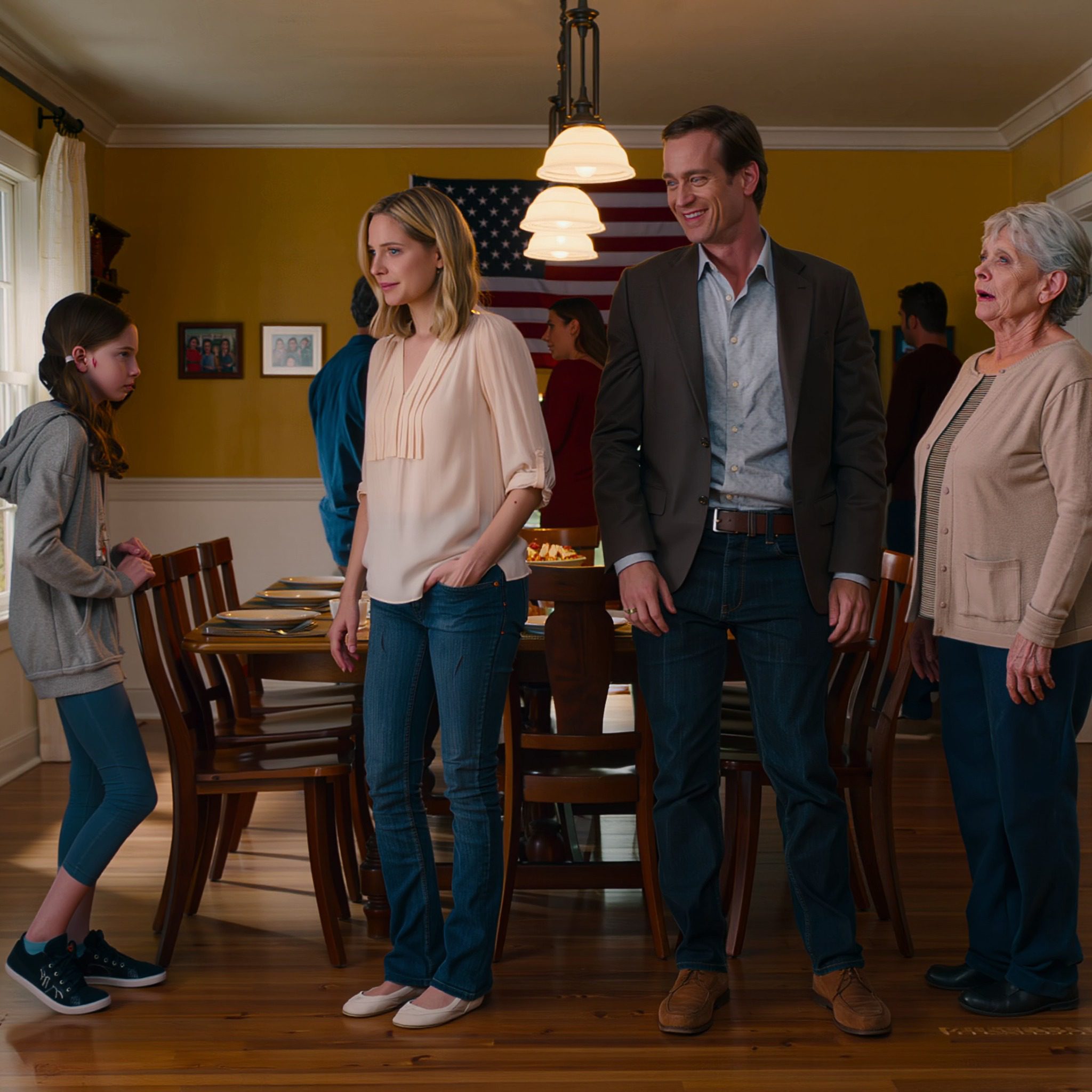
At one point, Bridget slid a piece of paper across the table.
“Mom wrote this last month,” she said. “Made me promise to give it to you.”
My name was on the front in shaky cursive.
I unfolded it.
Holly,
I don’t know if I’ll get to say everything I should say out loud. Talking has never been our family’s strength.
I see now that I taught you to endure when I should have taught you to walk away.
I watched you be strong and thought that meant you didn’t need protecting. I was wrong.
You protected yourself. Then you protected Kennedy. I am proud of you for that, even if it cost me.
If you never forgive me, I understand.
If you do, I hope it is for your peace, not mine.
Love,
Mom
I read it twice, then folded it back up.
“Are you okay?” Bridget asked.
“I’m… something,” I said.
Garrett hadn’t turned around once.
“Will you come to the funeral?” Bridget asked.
“Yes,” I said. “Kennedy will decide for herself.”
“And afterward?”
I met her eyes.
“Afterward,” I said, “we keep the boundaries that keep us sane.”
She nodded slowly.
“I figured,” she whispered.
Kennedy did come to the funeral.
She sat on the far end of the second pew, between me and Ms. Alvarez, who came even though she’d never met my mother.
“Support systems travel,” she said simply when I thanked her.
The service was exactly what Mom would have wanted—hymns, a slideshow of family photos, a casserole reception in the church fellowship hall.
There were pictures of every grandchild.
Including Kennedy.
In each photo, Mom’s arm was around her, smiling.
“This part was real,” Kennedy whispered, leaning into my shoulder. “Even if the rest wasn’t.”
After the graveside service, people lingered, hugging, murmuring, promising to “get together soon” in that way people do when they know they never will.
Garrett approached us once.
He looked smaller somehow. Not physically. Just… less.
“Holly,” he said.
I turned.
“Yes.”
His eyes flicked to Kennedy, then back to me.
“I’m… glad you came,” he said.
“Mom would have wanted that.”
“I know,” I replied.
He shifted his weight.
“I’m… sorry,” he said finally.
“For… everything.”
It was the vaguest apology I’d ever heard.
Ten years ago, I would have grabbed onto it like a life raft.
Now, I just nodded.
“Thank you for saying that,” I answered.
I didn’t say, I forgive you.
I didn’t say, Let’s start over.
Because some stories don’t have a reconciliation arc.
Some just… end.
Kennedy slid her hand into mine.
“Mom,” she said softly, “can we go home now?”
“Yes,” I said.
“We can.”
We left before the casseroles came out.
Years passed.
Kennedy got taller, then somehow shorter again as she learned to slouch into herself less. Her voice lost its little-girl lilt and gained a confident, measured cadence honed by countless debate rounds.
She got her driver’s license.
She got her heart broken for the first time by a boy with floppy hair who didn’t deserve her.
(We ate ice cream on the couch and watched old movies until she stopped crying over him.)
She got accepted to three colleges and waitlisted at her dream school—a small liberal arts college up north with Gothic buildings and a debate team that regularly went to nationals.
Her application essay?
You can probably guess.
She wrote about the water park.
About the porch.
About the day she learned that sometimes love looks like walking out of a dining room and never going back.
“Are you sure you want to send this to strangers?” I asked when she let me read it.
“They’re not strangers,” she said. “They’re people deciding my future. They should know who I am.”
Fair point.
Two months later, a thick envelope arrived from that dream school.
I stood in the foyer, heart pounding, while she sliced it open with a butter knife.
Her eyes flew across the page.
Then she screamed.
“Mom! I got in!”
We jumped up and down in the foyer like we were twelve ourselves.
Later that night, after the calls to friends and the celebratory pizza and the photos with the acceptance letter, she came into the kitchen holding her phone.
“Mom,” she said, “can I show you something?”
“Always.”
She pulled up an email.
Dear Ms. Griffin,
Your essay moved me more than any I’ve read in twenty years of admissions work.
We tell young people that family is everything. That they must sacrifice themselves to keep the peace. You showed us a different version of love—the kind that protects, that sets boundaries, that says “no more.”
This institution will be lucky to have you.
Welcome home.
—Director of Admissions
I read it twice.
“Home,” she repeated, tasting the word.
Then she looked at me.
“You gave me that,” she said. “The chance to have this.”
I shook my head.
“You earned this,” I corrected.
“I just… refused to let them take it from you before you even got started.”
She smiled.
“Same thing,” she said.
Graduation day came on a blistering hot June afternoon.
The high school stadium was packed—students in blue gowns, parents fanning themselves with programs, grandparents in sun hats.
Kennedy stood in the front row of chairs, honor cords draped around her neck.
Valedictorian.
When her name was called, she walked to the podium with the easy confidence of someone who had spent four years learning how to use her voice.
Her speech wasn’t about me.
It wasn’t about Garrett.
It wasn’t about the party.
It was about choice.
About learning which voices to turn down and which to turn all the way up.
“At some point,” she said, her voice ringing over the bleachers, “we all have to decide whose opinion matters. You can spend your life auditioning for people who will never clap for you, or you can turn around and find the people already standing, already cheering.
“I hope you pick the second group.
“And if you haven’t found them yet,” she added, smiling, “I hope you learn to be that person for yourself.”
The stadium erupted.
I clapped until my hands stung.
On the way out, weaving through the throng of families taking photos by the goalposts, I caught sight of a familiar face near the back fence.
Cole.
He stood alone, hands in his pockets, watching Kennedy pose with her friends.
I hadn’t seen him in person in almost a year.
He looked… okay.
Older.
Tired, but not broken.
When his eyes met mine, he lifted his chin in a small nod.
I nodded back.
We didn’t walk over.
We didn’t force a moment that wasn’t ours.
This wasn’t about us.
It was about the girl in the blue gown laughing in the sunshine, finally free of the weight of people who never deserved her.
If you’re waiting for the part where I say I forgave everyone and we all spend Christmas together now, you’re going to be disappointed.
That’s not the story I’m telling.
I forgive my mother, in my own imperfect way.
I hold space for the possibility that Bridget might someday decide to do her own work.
I wish Cole well, quietly, from a distance.
Garrett?
I don’t think about him much anymore.
Not out of bitterness.
Out of disinterest.
He became what he always was beneath the shine—a man whose choices finally caught up to him.
I don’t stalk his LinkedIn. I don’t ask around about where he’s working now or whether he moved out of that apartment.
He’s not my problem to solve.
He never was.
Sometimes, late at night, when the house is quiet and Kennedy’s laundry is finally folded and the dishwasher hums in the background, I think about that night at the country club.
I picture the marble floors, the fairy lights, the drone sweeping over the golf course.
I picture a table full of adults laughing while a twelve-year-old girl slipped out the side door in tears.
If I could go back, would I change anything?
I’d change one thing.
I’d leave sooner.
I’d walk out the second my brother said, “She’s not important enough.” I’d scoop up my daughter, grab my purse, and leave a trail of uneaten mashed potatoes behind me.
But I can’t go back.
All I can do is stand by the choice I made when the moment finally came.
I chose my daughter.
Over my brother.
Over my parents’ comfort.
Over keeping up appearances.
Over the idea that “family” means letting people hurt you without consequences.
And if you are sitting in your own version of that dining room, listening to people who are supposed to love you make you or your child feel small, I hope you hear my voice in your head when I say this:
You are allowed to leave.
You are allowed to close the door.
You are allowed to let their world fall apart if the only way it stays standing is on your back.
You don’t owe anyone access to your life just because you share DNA.
My younger brother said, “Your child isn’t important enough to attend my child’s graduation.”
He was wrong.
She was important enough for me to walk away from everything I’d been taught to protect.
She was important enough for me to say, “No more.”
And in the end, that choice didn’t just save her.
It saved me.
If this story reached something tender in you—if you’ve ever sat in a room full of people and felt more alone than you’ve ever felt in your life—know this:
You are not the problem.
The room is.
Find a new room.
Find your people.
Be your own people until they show up.
And when that moment comes—the one where you have to decide whether to keep the peace or keep your soul—I hope you remember a single mom in Charleston who chose her daughter’s worth over a five-million-dollar deal and a family’s fragile illusion.
I hope you remember that she never regretted it.
Not for a single second.
Some doors close so better ones can open.
And sometimes, you don’t wait for them to close.
You close them yourself.
When someone in your family treated your child as if they didn’t really matter, how did you respond? Have you ever had to choose your child’s dignity over “keeping the peace” at a family gathering? I’d truly love to hear your story in the comments.