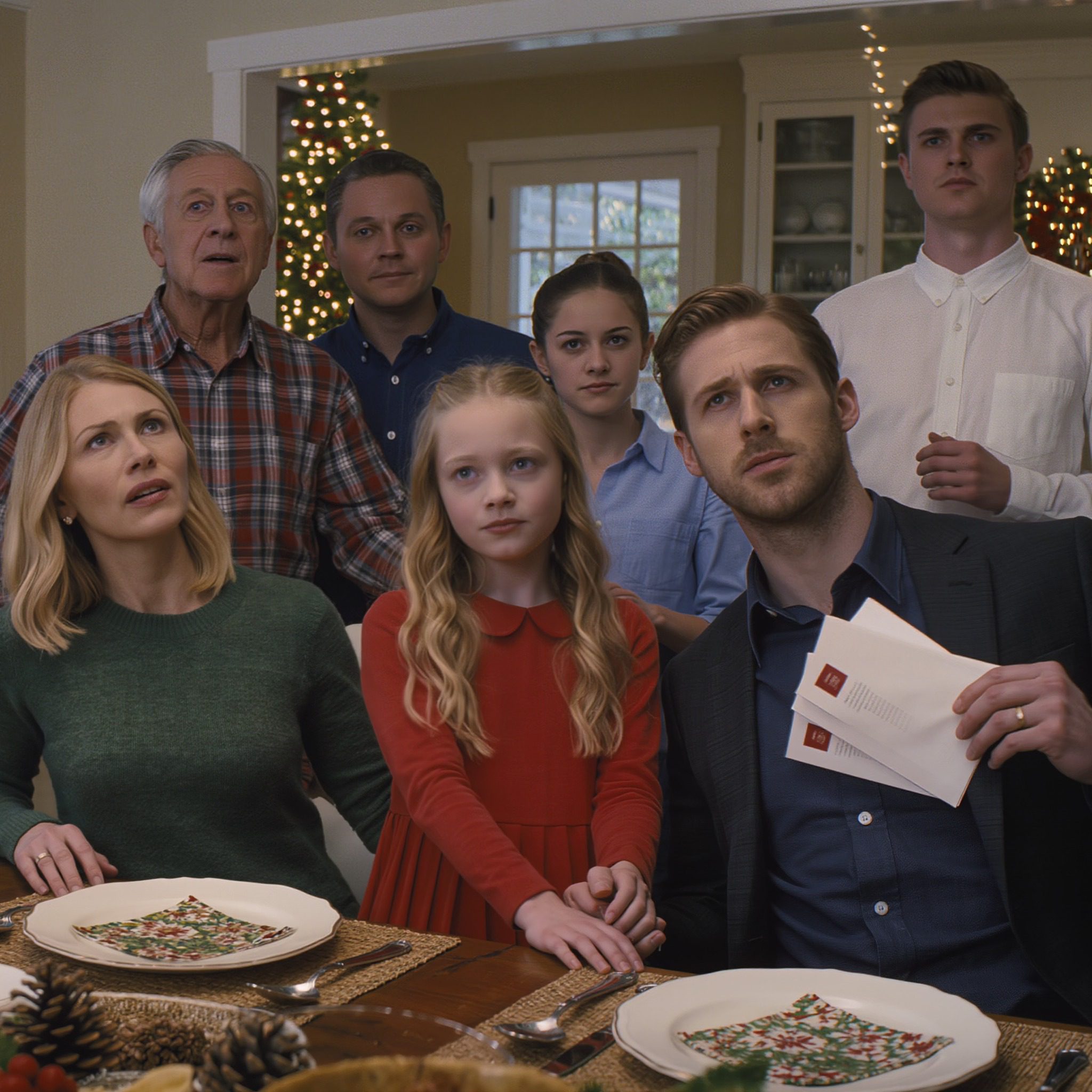
Maryanne’s smile faltered.
“Don’t be like this,” she said.
“It’s Christmas.”
Sloan’s voice cut in sharper.
“We’re doing this for her.”
Trent added.
“Family forgives, man.”
I rested my hand on the lock and felt the solid weight of it under my palm.
Laya’s small hand slid into my shirt from behind, gripping the fabric like an anchor.
I looked down at her.
At the trust in her eyes.
At the way she waited for me to choose.
The doorbell rang again.
More insistent this time.
“Just open the door,” Maryanne pleaded.
“Just talk.”
I didn’t move.
I knew then, with a certainty that felt almost peaceful, that whatever came next would define the rest of our lives.
And I wasn’t choosing comfort.
I was choosing my child.
I stood with my hand resting against the door frame, close enough to the lock that I could feel the cold metal through the wood.
Through the peephole, I could see all of them clearly.
Arranged like they’d rehearsed it.
Maryanne front and center.
Cake held at chest level.
Frosting smoothed perfectly.
Proof of good intentions.
Sloan a half step to the side.
Angled just enough to look cooperative rather than confrontational.
Trent behind her.
Arms loose.
Posture casual in that way men adopt when they expect to back someone else’s authority.
Graham stood off to the other side.
Shoulders squared.
Face set.
His silence heavier than any words he could have used.
I didn’t open the door.
I didn’t need to.
I turned slightly so my body blocked the hallway behind me.
Putting myself between them and Laya without making a show of it.
She was close enough that I could feel the small pressure of her fingers curled into the back of my shirt.
Maryanne leaned toward the door, her voice climbing into that sugary register she reserved for public moments.
“Laya, sweetheart,” she called, loud enough that the neighbors could hear if they were listening.
“Come give Grandma a hug.”
Laya didn’t move.
I felt her grip tighten.
Her body shifting backward instead of forward.
That reaction told me everything I needed to know.
Sloan noticed it immediately.
Her eyes flicked to the door, then narrowed.
“See what you’ve done?” she said sharply.
“You’ve scared her.
You’ve poisoned her against us.”
I opened the door just enough to be heard clearly.
Not enough to give them space.
“No,” I said.
“I didn’t poison anything.
You told me to leave and never come back.
You said Christmas was better without me.
You said it in front of my child.”
Maryanne’s smile faltered for half a second before she forced it back into place.
“We were upset,” she said quickly.
“Emotions were high.
You know how things get.”
“I know exactly how things get,” I said.
“And that’s why you’re not coming in.”
Graham finally spoke.
His voice low.
Controlled.
“You’re taking this too far.
You’re using one night to punish your family.”
I met his gaze through the glass.
“Punishment is throwing a child out of a home.
This is consequence.”
Het woord kwam harder aan dan ik had verwacht.
Maryannes toon veranderde.
De zoetheid verdwijnt.
‘Wat wil je, Bowen?’ vroeg ze.
“Vertel het ons gewoon.”
We kunnen dit oplossen.”
Daar was het.
Geen spijt.
Onderhandelen.
Sloan kwam er soepel tussen.
“Wij zijn volwassenen.”
We kunnen het over cijfers hebben.
We kunnen wel iets eerlijks bedenken.”
Trent knikte.
“Familieoffers voor elkaar.”
Verbrand niet alles in de as uit trots.
Graham haalde diep adem.
“Heb je enig idee wat dit met ons doet?”
Weet je wel hoeveel schade je aanricht?
Ik heb niet meteen geantwoord.
Ik keek naar beneden en voelde Laya’s voorhoofd zachtjes tegen mijn rug gedrukt.
Haar adem verwarmde mijn shirt.
‘Je hebt nog steeds niet gevraagd hoe het met haar gaat,’ zei ik.
Grahams kaak spande zich aan.
“Dat is niet het punt.”
En daar was het.
Sloans geduld raakte vervolgens op.
‘Je bent niet goed,’ zei ze.
Haar stem klonk plotseling kil.
« Iedereen kan dat zien. »
Je zou met iemand moeten praten.
Dit soort gedrag is niet stabiel.
Trent verplaatste zijn gewicht.
‘Laat ons dit niet op de moeilijke manier doen,’ voegde hij er zachtjes aan toe.
De dreiging lag daar op de loer.
Uitgepakt.
Ik voelde mijn hartslag bonzen in mijn oren.
Maar mijn stem bleef kalm.
‘Je hebt geen toegang tot mijn huis,’ zei ik.
“Je krijgt geen toegang tot mijn dochter.”
Alle communicatie vanaf nu zal schriftelijk verlopen.
Als je nog een keer opduikt, beschouw ik dat als intimidatie.”
“De camera heeft dit al die tijd opgenomen.”
Maryanne keek even omhoog.
Paniek flitste over haar gezicht.
‘Bowen, alsjeblieft,’ zei ze.
Haar stem breekt uiteindelijk.
“Doe de deur gewoon open.”
Ik heb niet gediscussieerd.
Ik verhief mijn stem niet.
Ik heb het gesloten.
Niet moeilijk.
Niet op dramatische wijze.
Ik draaide aan het slot en voelde het met een stevige klik op zijn plaats vallen.
Ik knielde voor Laya neer en legde mijn handen op haar schouders.
‘Je bent veilig,’ zei ik zachtjes.
« Niemand mag je ooit nog het gevoel geven dat je ongewenst bent. »
Ze knikte eenmaal.
Toen sloeg ze haar armen om mijn nek.
Nadat hun voetstappen waren weggeëbd, heb ik de beelden van de deurbel opgezocht en opgeslagen.
Vervolgens maakten ze een back-up van de berichten die ze daarna hadden verzonden.
Degenen die het hadden over het herstellen van de problemen en het ongedaan maken van wat ik had gedaan.
Eén voicemailbericht van Maryanne viel me in het bijzonder op.
Ze heeft Laya geen enkele keer genoemd.
Ze vertelde hoe hecht ze waren geweest.
Hoeveel hulp ze bijna hadden gehad.
Het exacte bedrag dat ze uitpuilde voordat ze zichzelf kon corrigeren.
Ik ging op de keukenvloer zitten en begreep iets met pijnlijke helderheid.
Het was pas voorbij toen de waarheid volledig aan het licht was gekomen.
De tijd verstreek in kleine, weloverwogen stapjes.
Weken werden maanden.
Ik heb onze dagen stukje voor stukje opnieuw opgebouwd.
De manier waarop je na een storm weer opbouwt, wanneer je je geen nieuwe instorting kunt veroorloven.
Laya’s ochtenden werden weer voorspelbaar.
Ontbijten op hetzelfde tijdstip.
Dezelfde rit naar school.
Dezelfde plek aan tafel waar ze het raam kon zien.
Ik hield mijn telefoon zoveel mogelijk uit het zicht.
Meldingen gedempt.
Gefilterde berichten.
Ik zag de spanning langzaam van haar schouders verdwijnen.
Alsof er lucht ontsnapt uit een strakke knoop.
Ze sliep dieper.
Ze lachte zonder eerst de kamer te controleren.
Ze stopte met vragen wanneer we teruggingen naar het huis van haar grootouders.
Als ze ze al noemde, deed ze dat op een zachte toon.
Voorzichtig.
Like testing a bruise.
I never lied to her.
I just told her the truth in pieces she could carry.
I organized everything the way I’d learned to do in the months after Evelyn died.
Chronological.
Clean.
Screenshots.
Dates.
Statements.
Footage.
I didn’t post constantly.
I didn’t argue online.
I kept the record ready in case it was needed.
When rumors resurfaced, I shared facts privately and shut the door again.
Eventually, the noise dulled.
People lost interest when the story stopped changing.
I made one final public clarification.
Brief.
Unembellished.
I stated the settlement amount plainly.
Without drama.
Without apology.
I explained what it was.
Compensation for a preventable loss.
Not luck.
Not a reward.
I said that before Christmas, I had planned to help my parents substantially.
To clear their debts and stabilize their future.
I said that plan ended the moment my daughter was told she didn’t belong.
I didn’t insult anyone.
I didn’t need to.
The truth did its own work.
Then I moved on.
I bought a modest home in my own name, close enough to Laya’s school that she could ride her bike on quiet afternoons.
I set up her college fund.
An emergency account.
Long-term investments designed to grow slowly and safely.
I didn’t chase anything flashy.
I chased stability.
Through distant relatives and secondhand updates, I heard what happened to them.
The house sold.
Retirement plans unraveled.
Sloan stopped posting family photos and pivoted to vague quotes about betrayal and resilience.
Maryanne and Graham told anyone who would listen how close they’d been to help.
How unfair it all was.
What they never said—not once—was that they were sorry for what they’d said to a child.
That absence told me everything.
I still miss Evelyn.
That grief didn’t evaporate.
Some mornings it still hits hard.
Sudden and sharp.
Money didn’t fix that.
What it did was remove the fear that had wrapped itself around my chest.
The fear that I would have to choose between survival and dignity.
I chose my daughter.
I chose safety over approval.
One evening, I stood in the kitchen of our new place while Laya ran down the hallway laughing, calling my name without hesitation.
Without shrinking herself first.
I leaned against the counter and let the quiet settle.
It wasn’t perfect.
It was enough.
And for the first time, I knew I would never go back to that table.
And I didn’t need to be invited to feel whole.
When the noise finally fades, what stays with us isn’t the argument or the money or who stood where.
What stays is the quiet understanding that some moments change the shape of our lives forever.
We don’t always recognize them when they arrive.
Sometimes they look like loss.
Sometimes they sound like rejection.
But later, when we breathe again, we realize those moments were asking us a single hard question about who we’re willing to protect and what we’re willing to let go of.
If this story leaves anything behind, I hope it’s this gentle thought we can hold together for a moment.
That compassion doesn’t always look like forgiveness.
Kracht hoeft niet altijd opvallend te zijn.
Soms is het een kwestie van veiligheid boven goedkeuring verkiezen.
Soms is het kiezen voor vrede in plaats van begrepen te worden.
En soms betekent het accepteren dat we niet elke relatie kunnen redden zonder onszelf daarbij te verliezen.
Dat maakt niemand automatisch een schurk.
Dat maakt ons gewoon menselijk.
We proberen het beste te maken van de situatie waarin we ons bevinden.
Dank u voor het luisteren naar dit verhaal.