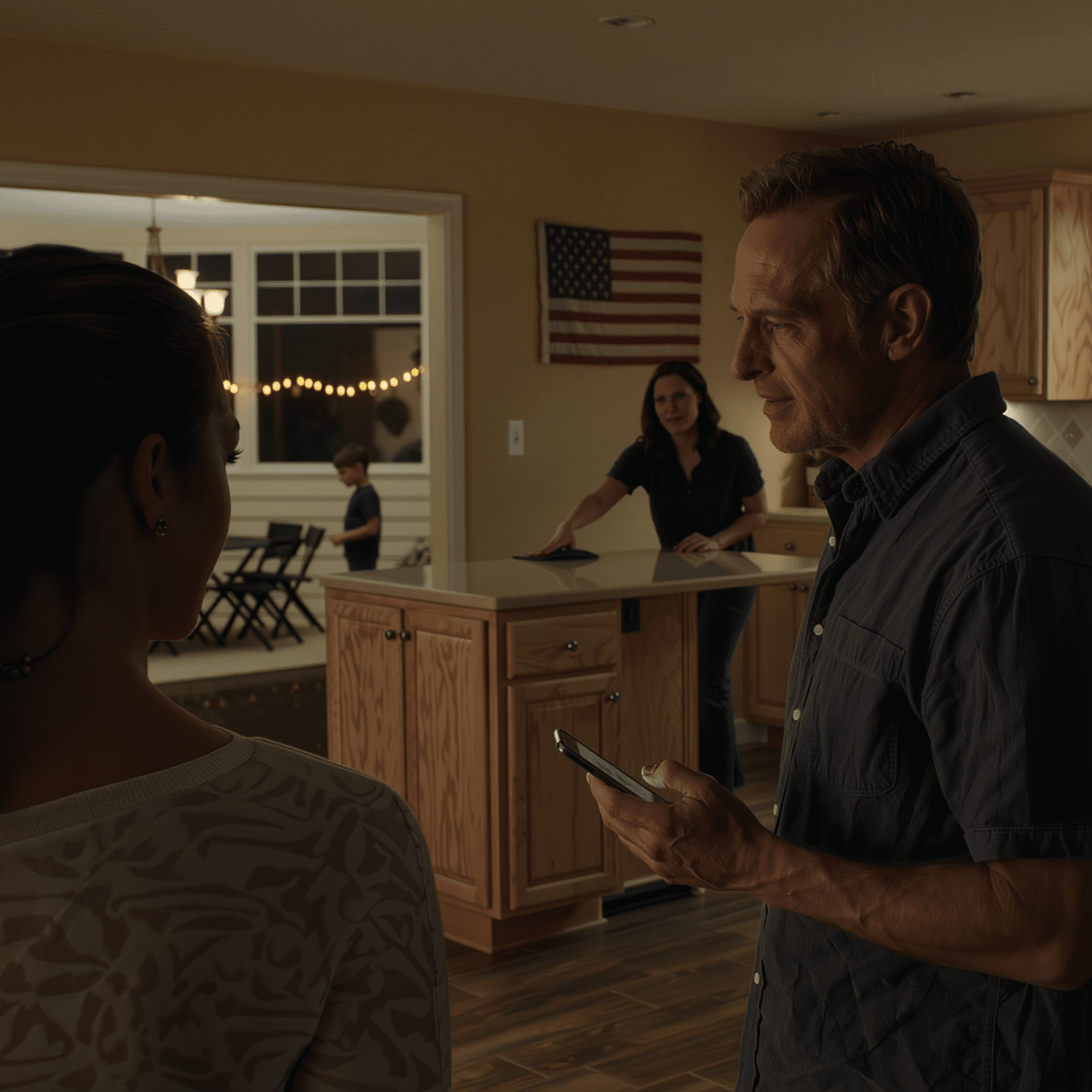
Cole stopped beside me, and I felt rather than saw my mother taking him in, assessing, recalculating. My father gave me a curt nod.
“He’s stable,” he said. “They think it was an arrhythmia episode, possibly brought on by stress and dehydration.”
Stress. Of course that word entered the room before love did.
“Can I see him?” I asked.
My mother folded her arms. “The nurse said short visits.”
“I didn’t ask for the hospital policy.”
Her mouth tightened. “Audrey.”
My father stepped in with that old boardroom tone. “This isn’t the time for attitude.”
I looked at both of them, standing there in a corridor full of pale lighting and closed doors, and something almost funny moved through me. They had not changed at all. Time had altered their address, their finances, their public shine. It had not touched the reflex that treated me like a problem to be managed.
“I’m going in,” I said.
And I did.
Walter looked smaller in a hospital bed than he ever had in his own house, which frightened me more than the wires did. There were leads on his chest, a monitor above his shoulder, a thin blanket over his legs. But his eyes were clear, and the first thing he said when he saw me was, “You came fast.”
I almost laughed and cried at the same time.
“Of course I did.”
He glanced toward the hallway. “Your parents out there acting like they own the waiting room?”
That was so unmistakably Walter that my throat closed up.
“A little.”
“Hm.” He shifted carefully. “Then stay in here a minute. Feels quieter.”
So I sat beside his bed and told him about a ridiculous professor who used the phrase market disruption like it was a religious experience. I told him Cole had driven. I told him Linda was on her way. I did not ask him whether he was scared because I could see the answer on the edges of his face. He did not tell me not to worry because we were long past using politeness as denial.
After a pause, he said, “I put your name down.”
“For what?”
“Emergency contact. Medical proxy if they needed one fast.”
I blinked. “Me?”
He looked at me like it was obvious. “You answer your phone.”
That simple sentence hit harder than anything else in the room.
Because underneath it was the truth neither of my parents could stand: love had become measurable, and not in sentiment.
In presence.
—
Walter was discharged the next afternoon with medication adjustments, stern instructions about hydration, and a follow-up with a cardiologist in two weeks. Linda drove down in time to help bring him home. My parents hovered just long enough to make their concern visible, then started circling around logistics the way vultures circle around ownership.
My father waited until Walter was in the passenger seat of Linda’s SUV before pulling me aside near the curb.
“You didn’t need to make things harder in there,” he said.
I stared at him. “Harder than what?”
He lowered his voice. “We are still his family.”
The word family again. Always used like a key, never like a responsibility.
I said, “You’re related to him. That’s not the same thing as showing up in the way he needs.”
My father’s face cooled. “Your grandfather is vulnerable right now. This is not the time to insert yourself into decisions that don’t concern you.”
Insert yourself.
As if I had drifted in on opportunism instead of Interstate highways and fear.
“What would you call the person he listed on his paperwork?” I asked.
My father looked caught for half a second, which told me more than the words did. He already knew.
So that was what this was really about.
Not Walter’s health.
Access.
My mother came over before he could answer. “No one is trying to fight with you.”
I looked at her and thought, maybe not consciously. But some people know only one way to stand near power, and it always looks like possession.
Walter cracked the passenger window and called my name.
Not loudly.
He didn’t need to.
I turned and walked away from my parents without another word.
Some truths arrive in sensible shoes and hospital bracelets.
That weekend, I stayed in Naperville to help Walter settle back in. Cole returned to campus Sunday night with a hug and a promise to send me class notes. Linda stocked Walter’s freezer like she was preparing for a regional emergency. The house slowed down. Medication bottles appeared in a neat row by the sink. A follow-up appointment got added to the fridge calendar. Walter complained about being treated like old furniture, which was how we knew he was feeling more like himself.
On Monday morning, while I was making toast, he said, “I want you to come with me to see my attorney this week.”
I looked up. “Why?”
He spread marmalade on toast with maddening calm. “Because I dislike confusion. And because your parents mistake confusion for opportunity.”
“Grandpa.”
“I’m serious.” He took a bite, chewed, swallowed. “The hospital reminded me that people get sentimental in waiting rooms and strategic in parking lots. I’m too old to pretend I don’t know the difference.”
The attorney’s office was in Wheaton, above a bank with a beige lobby and the kind of carpeting designed to make financial decisions feel respectable. Walter had already drafted most of what he wanted: updated health care directives, a durable power of attorney if he ever needed one, and clear instructions that his house and the larger portion of his estate would pass into a trust managed for me.
I sat there with the fountain pen he had once given me tucked into my bag and felt the room tilt.
“Grandpa,” I said quietly, once the attorney stepped out to print something, “you do not have to do this because of me.”
Walter turned toward me in his chair. “I’m not doing it because of you. I’m doing it because of me.”
“That’s not less intense.”
It earned a brief smile. Then he grew serious again. “Audrey, I’m not rewarding you. I’m choosing the person I trust not to confuse love with entitlement.” He let that settle. “Responsibility should go where character already lives.”
I looked down at my hands because suddenly I could not look anywhere else.
He added, softer, “And before you start feeling guilty, understand something. This is not a punishment for them either. This is clarity.”
Clarity.
He always used that word when other people wanted drama and he wanted a straight line.
I signed nothing that day except a witness line where he asked me to. But I walked out understanding that one of the final adult tests is learning not to reject care just because it arrives after a lifetime of being denied it.
That should have felt simple.
It didn’t.
When my parents found out about the legal updates, they reacted exactly the way people do when the future stops assuming them.
My mother sent an email first, long and polished and wounded in all the places performance usually is. She said Walter was acting rashly under emotional influence. She said I had inserted myself during a moment of medical vulnerability. She said decent daughters did not use temporary conflict to isolate elderly relatives from the rest of their family.
Then my father called from an unknown number when I didn’t respond.
I answered because I was tired of pretending silence alone could teach lessons people refused to study.
“You’ve crossed a line,” he said instead of hello.
“Interesting,” I said. “That’s the word you choose.”
“You know exactly what I mean.”
“No,” I said. “I know what I mean when I say line. It usually has something to do with dignity.”
He exhaled through his nose like I was a difficult employee. “Your grandfather is emotional. You are too young to understand what these decisions imply.”
I looked out the guest room window at Walter’s backyard, where the string lights were still looped neatly across the fence from the summer barbecue. “I understand more than you think.”
“What would you do,” I wanted to ask him, “if the people who failed you kept showing up in new packaging, asking for access and calling it reconciliation?”
Instead I said, “You can talk to your attorney if you have legal questions. But you don’t get to make me responsible for your disappointment.”
Then I hung up.
I was shaking afterward.
Not because I doubted myself.
Because doubt had been trained into me so early that even when I was right, my body still remembered the old punishment.
That night I sat on the back steps while Walter watered the hostas and wondered whether boundaries always felt this expensive at first. He finished with the hose, set it down, and looked at me for one long quiet second.
“Still thinking like the one who has to make this easier for everybody else?” he asked.
I gave a tired laugh. “Sometimes.”
He nodded. “That’s a habit, not a duty.”
I carried that sentence back to campus with me.
It lasted.
—
The next apology I got was the one I never expected.
It came almost a year later, at the start of senior spring, in the form of a voicemail from a number I didn’t recognize. I was walking back from class when I listened to it the first time. By the second sentence, I had stopped moving.
It was Brandon.
His voice sounded older, though maybe what I really heard was the absence of swagger. He didn’t launch into excuses. He didn’t say family first. He didn’t mention money, Walter, or our parents’ office. He said he knew I might never call back and that he wasn’t leaving the message to change that. He said he had spent a long time telling himself everyone had overreacted because admitting what he had done would have required admitting who he had been.
Then he said the sentence I had not known I needed to hear.
“I really did make your life smaller any time mine felt threatened.”
I stood there on the sidewalk with students flowing around me and felt the whole world go strangely still.
He went on. He said losing the internship hadn’t ruined him. What ruined him, for a while, was realizing that once our parents no longer had money and status to cushion everything, people stopped mistaking his confidence for substance. He said working retail and then finishing a certification program online had forced him into a kind of ordinary life he had once treated like an insult. He said ordinary turned out to be clarifying. He had started therapy. He said the parking lot scene from years earlier came back to him more often than he liked because it was the first time he had seen someone refuse to be moved by him.
“I’m not asking you to fix anything,” he said at the end. “I just needed you to hear me say I was wrong.”
Have you ever waited so long for an apology that when it finally arrived, the first feeling wasn’t relief but distance?
That was what I felt.
Not triumph.
Not instant forgiveness.
Distance.
I listened to the message three times that night. On the fourth, I wrote back a single text.
I heard you. Thank you for saying it clearly. I’m not ready for more than that.
He answered with one line.
That’s fair.
And for the first time in my life, Brandon let the boundary stand without trying to climb over it.
That mattered.
More than I expected.
My parents never got there, at least not fully. There were holiday cards some years, stiff and careful. A forwarded article once from my mother about women in leadership, as if a link could substitute for an actual relationship. A text from my father after I made dean’s list again, only four words long: Congratulations. Proud of you. I stared at that message for a full minute before deleting it.
Maybe he meant it.
Maybe he meant the version of pride that costs nothing.
By then, I no longer needed to solve the difference.
Senior year moved fast after that. Job fairs. Capstone projects. Interviews in blazers that never fit quite right in the shoulders. Cole got an offer in Chicago. I accepted a position with a mid-sized marketing firm in the western suburbs, close enough to Walter that Sunday dinners would stay possible. When I called him with the news, he answered on the second ring and said, “I had a feeling,” in the exact tone some people reserve for winning lottery tickets.
Then came graduation.
The college one.
The one nobody could cancel.
Memorial Stadium was loud and windy that May, full of families holding flowers, cameras, paper fans, and too much emotion for one set of bleachers. I zipped my gown over my dress and looked out at the crowd before the ceremony began. Not because I expected to see my parents. I had not invited them. I looked because for years I had been trained to search every room for absence first.
This time, I made myself look for presence.
Walter was there in a navy blazer and sunglasses, one hand wrapped around the railing, Linda beside him in orange because subtlety had never been her ministry. Cole was there. Zoe had come down for the weekend too, waving like I might somehow miss her in a stadium. Every face that mattered to me was turned in my direction with something clean in it.
Not ownership.
Not comparison.
Joy.
When they called my name and I crossed the stage, the applause that reached me was not the loudest in the stadium.
It didn’t need to be.
It was mine.
Afterward we took pictures under a stand of trees while champagne-colored confetti from somebody else’s photo shoot blew across the sidewalk. Walter tired more easily by then. He moved slower, sat when he needed to, and pretended not to notice any of it. But when he hugged me, he held on long enough that I felt the whole arc of my life tightening and releasing at once.
“You were never hard to celebrate,” he said quietly into my hair.
It was such a simple sentence.
It wrecked me.
That night we drove back to his house instead of staying in Champaign. Linda insisted on bringing takeout from a steak place off the interstate. Cole picked up a cake. Zoe came too. And when we stepped into Walter’s backyard after sunset, the string lights were already on.
Same warm glow.
Same soft gold along the fence.
Different life.
There were no empty chairs this time. Every seat had a person in it. Every person in it had chosen to be there. The air smelled like summer grass and grilled onions and cake frosting. Somebody laughed from the patio. Cole handed me a plate. Linda told a story too loudly. Walter sat at the head of the table with his water glass and that small satisfied look he got when reality finally behaved better than the people in it.
I stood there for one second and let the picture settle all the way into me.
The first time string lights framed my erasure.
Now they framed my life.
That was the whole difference.
Later, when the plates were cleared and the cake was half gone, Walter handed me a flat box wrapped in brown paper. Inside was the gold acrylic 18 topper, mounted in a simple shadow frame with the leather planner card he had given me years earlier.
For the beginning of whatever comes next.
He had added one more line underneath in his square handwriting.
You did not become smaller to survive. Don’t start now.
I laughed because otherwise I was going to cry again, and I had already done enough of that to entertain Linda for one night.
When the evening finally thinned and people started gathering bags and leftovers, I stayed outside a little longer under the lights. Cole came up beside me and slipped his hand into mine. The house behind us hummed with the soft after-sound of people who had eaten well and loved honestly.
For a long time, I thought closure meant hearing the right words from the wrong people.
It didn’t.
Closure was building a life that no longer waited at the window for their headlights.
Het ging erom te begrijpen dat grenzen geen straffen zijn. Het is architectuur. Ze ondersteunen het leven dat je probeert te leiden. Ze bepalen wat er door de voordeur komt en wat niet. Ze laten liefde binnen zonder dat chaos de sleutel in handen krijgt.
Als je dit op Facebook leest en een deel van mijn verhaal je is bijgebleven, vraag ik me soms af welk moment het meest impact had: de lege stoelen onder de eerste lichtslingers, het berichtje ‘s middags dat mijn avond afzegde zonder het me te vertellen, mijn grootvader die vroeg of ik met hem mee naar huis wilde, Brandon die me in het nauw dreef op die schoolparkeerplaats, of de tweede diploma-uitreiking waar elke stoel die ertoe deed bezet was. En ik vraag me af wat de eerste grens was die jij ooit met je familie hebt gesteld, ook al leek die op dat moment klein. Soms is de kleinste grens degene die je uiteindelijk leert waar je voor staat.