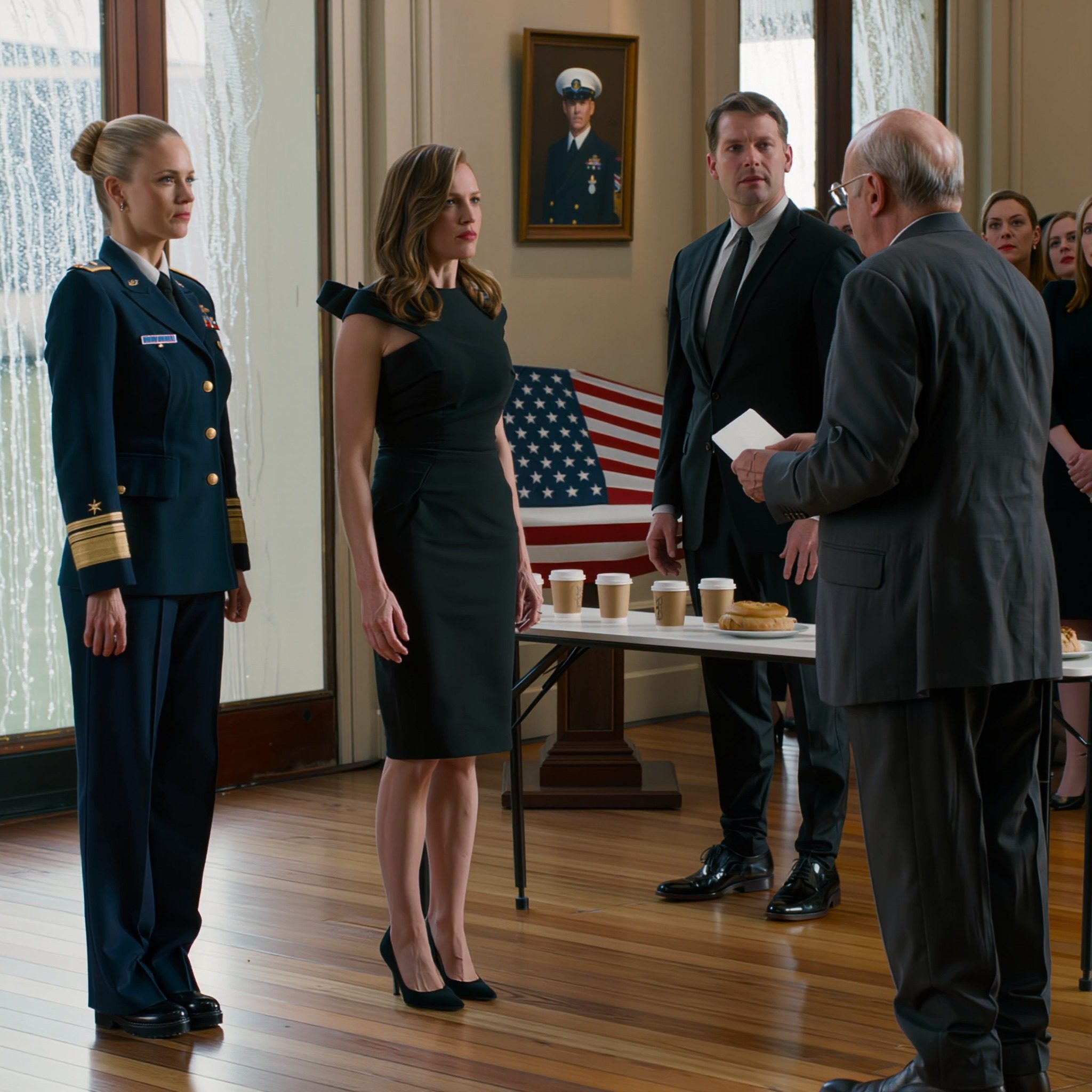
Afterward, groups toured the new classrooms and workshops. One room had welding stations, another had computers ready for IT training. A third was set up for small business coaching. Sabrina led a group of local reporters through the media room, explaining how the ranch partnered with businesses. She sounded like a professional, but not slick—just clear. Cole showed a logistics manager from Helena how the distribution hub connected with the vineyards. He looked like he’d been doing it for years.
I moved through the rooms quietly, listening. Veterans explained programs to visitors without prompting. Kids ran between tables eating cookies. The smell of fresh paint mixed with coffee and sawdust. It felt like something built to last.
By lunchtime, the formal part of the event was over. People sat at picnic tables eating sandwiches. My mother found me near the greenhouse.
“You’ve done a good thing,” she said simply.
“I didn’t do it alone,” I replied.
She smiled faintly. “Your grandfather knew you wouldn’t.”
We walked toward the new center together. Sabrina was talking with a group of female veterans about social media campaigns. Cole was loading boxes into a van for a delivery. They didn’t look like heirs anymore. They looked like staff.
Later in the main lodge, Conrad handed me a folder. “Financials for the new wing,” he said. “We’re under budget. We can start the Colorado site next year if you want.”
“Let’s finish this one first,” I said.
He chuckled. “Practical as ever.”
As evening approached, the guests left and the ranch settled back into its rhythm. I found Sabrina on the porch of the main lodge, sitting with a mug of tea. She looked tired but calm.
“You did well today,” I said.
She gave a small laugh. “I didn’t do anything. The staff did everything.”
“That’s the point,” I said. “Good systems don’t need a hero.”
She looked at me, eyes clearer than I’d ever seen them. “I was wrong about all of it,” she said quietly. “The company, the money, Grandpa—all of it.”
“I’m not here for an apology,” I said.
“I know.” She paused. “But I want to stay. Cole, too. We’re learning things we should have learned a long time ago.”
“That’s your choice,” I said. “There’s work here if you want it.”
Her eyes filled for a second, but she blinked it away. “Thank you.”
Cole came out of the warehouse wiping his hands. “Trucks loaded for tomorrow,” he said, almost like a report. He looked at me. “We’re not going back to New York. We’re done with that.”
“Good,” I said simply.
We stood together on the porch, watching the sun dip behind the hills. Veterans were gathering at the fire pit, some playing guitars, others talking quietly. Service dogs trotted between them. The air smelled of pine and wood smoke. My mother joined us, leaning on the railing.
“He’d like this,” she said softly.
I reached into my jacket pocket and touched the folded letter. “He’d like that you’re here,” I said.
The four of us stood in silence as the sky turned orange and then deep into blue. It wasn’t a dramatic reconciliation—no tearful speeches or grand gestures—just people standing on the same porch, finally facing in the same direction.
Inside the lodge, staff cleared tables from the day’s event. Frank walked past carrying a box of leftover name tags. “Good day,” he said simply.
“Good day,” I agreed.
Later, back in my cabin, I opened the trust documents again. Not because I doubted them, but because the numbers now felt like something alive. This wasn’t an inheritance anymore. It was an operation. And for the first time, it was a family operation built on work instead of appearances.
Outside, the hills were quiet. Lights glowed from the new center. The smell of sawdust still lingered in the cool night air. Tomorrow there would be more tasks, more shipments, more training—the normal rhythm of a place that functioned without fanfare.
The Montana morning, a year later, felt sharper and cleaner than I remembered. Frost clung to the grass by the training field as the first trucks rolled in. I stood on the porch of the Whitmore Veterans Renewal Center in my reserve uniform, coffee in hand, watching veterans head to classes and workshops. The place had doubled in size since last fall: two new cabins, a small daycare for veterans’ kids, and a second greenhouse were up and running. The Colorado site Conrad had once mentioned was now halfway through construction with local veterans leading the project.
Inside the lodge, the walls were covered with updated photos of graduates holding certificates, shaking hands with new employers, or standing in front of businesses they’d started. The board by the entrance showed job placements across ten states. Next to it was a simple frame containing my grandfather’s original letter. No fanfare, just the words he’d written to me. People stopped to read it sometimes, but no one made a speech about it.
I walked through the main hall, nodding at familiar faces. Sabrina sat at a desk with two of her marketing staff, finalizing a social media calendar that actually drove donations and volunteer signups. She wore jeans and a fleece vest with the ranch logo, her hair pulled back, no jewelry except a small silver cross. She’d stopped curating her life for cameras and started telling real stories about the people here.
Cole was out at the distribution hub supervising a shipment of wine to a new client in Texas. He’d learned to keep manifests, negotiate trucking contracts, and run numbers without hiding liabilities. Their salaries weren’t huge, but they were proud of their paychecks.
Conrad met me by the coffee urn. “Got a message from the Colorado crew this morning,” he said. “They’re ahead of schedule. Snow didn’t slow them down.”
“That’s good news,” I replied. “We’ll send extra materials next week.”
We stepped outside together. The air smelled of pine and diesel like every morning here.
“You realize you’ve built a model people are starting to copy,” Conrad said. “Two senators called last week asking how this works.”
I shrugged. “Let them copy it. More veterans get help.”
He gave me a half smile. “Thomas would say, ‘Checkmate.’”
I smiled back. “He’d say, ‘Keep moving pieces.’”
A group of veterans approached, one carrying a plaque. “Captain Whitmore, we wanted to give you this,” the man said. “For the anniversary.” It was a simple wooden board with the ranch logo burned into it and the words SERVICE OVER STATUS. I ran my fingers over the engraving.
“Thank you,” I said. “This belongs to all of you.”
They grinned and went back to work. I looked across the property. Kids ran between cabins. Service dogs trotted at their handlers’ sides, and a forklift beeped near the warehouse. The whole place moved like a living organism—no single person at the center. That was the point.
Later in the day, I drove down to the vineyard in the valley to check on operations there. Rows of vines stretched out under a pale sun, leaves turning gold at the edges. Marco, the Italian cousin who’d come over to help manage production, waved from a tractor. The winery building smelled of oak barrels and fermenting grapes. We walked through the storage area together, checking inventory.
“The American distribution is stable now,” Marco said. “Cole’s doing a good job.”
I nodded. “He needed a mission.”
Back at the ranch, I walked the path past the fire pit. Sabrina was sitting with two veterans discussing a new outreach program for women transitioning out of the military. Cole was on the phone coordinating a delivery. Conrad was in the office reviewing grant proposals. Nobody looked at me for orders. They just worked. It felt like a unit that had achieved full operational capability—sustainable, disciplined, flexible.
In my cabin, the original envelope with the plane ticket sat in a small frame on the shelf. Next to it was the last bottle of wine my grandfather had personally produced before he died. The label read “Ereda 2024.” Underneath, in his handwriting: For Riley, who understood the best inheritance isn’t what you’re given, but what you’re trusted to continue.
I poured a small glass from a newer bottle of the vineyard’s wine and sat at the desk. Outside the window, the hills glowed orange in the late sun. The sounds of the ranch drifted in—hammers, laughter, a service dog barking once. I thought about that day at the funeral when everyone laughed as I held a wrinkled envelope. They’d thought it was nothing. It had been everything.
When Frank Holden first held up the sign with my name at that small Montana airport, it was as if he’d said six words I wouldn’t understand the full weight of until now: Your grandfather built this for you. Not a yacht, not a penthouse—a mission. The weight of that was no longer heavy. It was steady.
I took a sip of wine and looked at the photo of my grandfather in his Navy uniform pinned above the desk. He wasn’t smiling in the picture, but in my memory of the ranch, he always did. A knock at the door. It was Sabrina.
“We’re grilling tonight,” she said. “Staff asked if you’d join.”
“Be right there,” I said.
She hesitated. “Thank you,” she said quietly, “for not giving up on us.”
I nodded. “Thank Grandpa. I just followed orders.”
She smiled and left. I sat for a moment longer, then stood, sliding the framed letter back into my pocket like a compass. Outside, the sky was clear and full of stars. People were gathering by the fire pit, guitars coming out, voices mixing. The smell of grilling meat drifted on the cold air.
It was just another evening at the ranch—steady, working, real. I walked toward the group, boots on gravel, shoulders light—no speeches, no headlines, no game left to play. Just the work, the land, and a family rebuilt one task at a time.
Standing there by the fire with veterans, staff, Sabrina, and Cole around me, I realized there was nothing dramatic left to say. The ranch wasn’t a symbol or a twist in some hidden game anymore. It was just people doing work that mattered, earning dignity one task at a time. My grandfather hadn’t left me a secret fortune. He’d handed me a living system and trusted me not to ruin it. That wrinkled envelope everyone mocked had turned into a place where soldiers, families, and even my own sister could start over. Looking at their faces in the firelight, I knew this was the real inheritance: service over status, trust over titles, and the quiet satisfaction of building something that lasts.