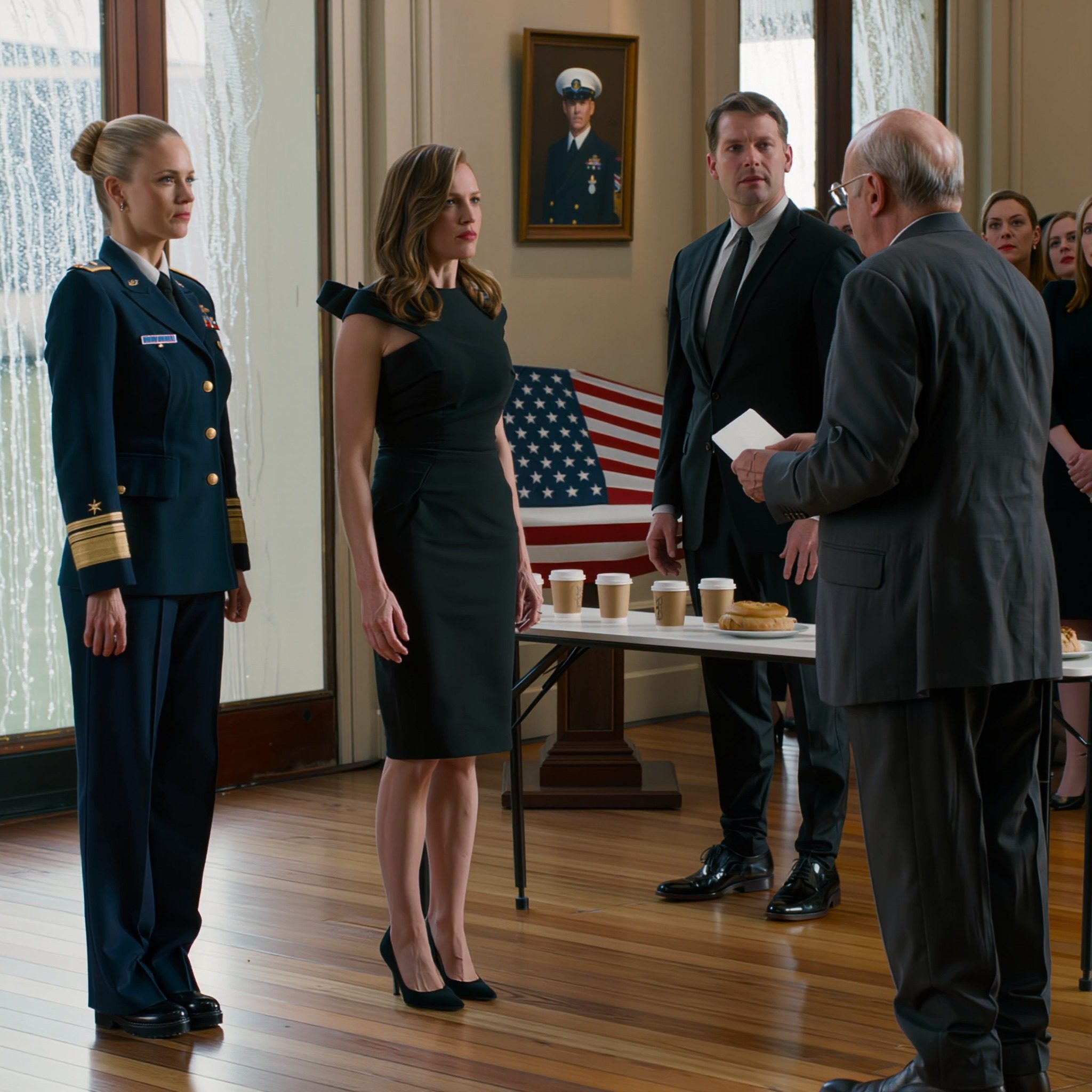
The rain was steady but polite at Arlington that morning, the kind that soaked your shoes without ever turning into a storm. I stood there in my army dress uniform, collar tight, cap tilted just right, watching the flag fold with practiced hands. Captain Riley Whitmore, Army logistics, present and accounted for. It was my grandfather’s funeral, but it felt more like a press event. Reporters lingered at the gates, and every time the honor guard moved, phones came out like it was a show. My sister Sabrina stood across the grave in a black designer dress that probably cost more than my monthly housing allowance. Her husband Cole Bennett adjusted her umbrella for her as if they were royalty. They looked like the stars of a lifestyle magazine. The grieving heiress and her handsome power husband. People whispered their names as they passed. Dun Defense Logistics, our family’s defense contracting company, had been on the front page enough times that they were minor celebrities in certain circles.
I didn’t hate them. I just stopped trying to understand them years ago. I joined the army straight out of college, partly to get away from the family machine, partly because I actually liked serving. Sabrina stayed close to Grandpa Thomas Whitmore, learning the company inside out, while Cole courted her at business conferences. By thirty, she was the face of Dun Defense. By thirty-four, I was the officer in charge of moving pallets of ammunition and MREs from one base to another. We each made our choices.
After the honor guard fired the final salute, we were ushered into the reception hall next to the cemetery. It smelled like polished wood and strong coffee. A long table held pastries no one was eating. A giant portrait of my grandfather in his Navy uniform stared down at us like he was still giving orders. I found a corner near the window and kept my posture straight. Years of inspections had trained me to stand still even when I wanted to bolt.
Sabrina, meanwhile, worked the room like a campaign stop. She shook hands, whispered condolences, and let people compliment her outfit. Cole smiled at everyone but never actually listened. When the family attorney, Mr. Harwick, cleared his throat, the noise dropped instantly. He was a thin man in his sixties with glasses that slid down his nose every time he looked up. He carried a leather folder that probably held the future of everyone in the room.
“Thank you all for coming,” he said, voice calm but firm. “Mr. Whitmore left very specific instructions. We’ll proceed exactly as he wanted.” Sabrina’s chin lifted a little. Cole squeezed her hand. I just stayed quiet, arms at my sides.
“To my granddaughter, Sabrina Whitmore,” Harwick began, “I leave controlling interest in Dun Defense Logistics as well as the family residence in Wyoming.” Gasps and murmurs rose. Sabrina didn’t even pretend to be surprised. She nodded once, gracious like a queen accepting her crown.
“To Mr. Cole Bennett,” Harwick continued, “I leave the Bennett Investment Trust and the vacation property on Lake Tahoe.” Cole gave a small, satisfied smile. My stomach tightened. I already knew where this was going.
“And to Captain Riley Whitmore,” Harwick said, pausing just long enough to make eye contact with me, “I leave this.” He reached into his folder and pulled out a small white envelope, the edges bent and soft. My name was scrawled across it in my grandfather’s shaky handwriting.
For a second, no one spoke. Then I heard it, a chuckle from someone in the back. Another person snorted. By the time I reached out to take the envelope, there were outright laughs. Sabrina’s voice cut through the noise, smooth and pitying. “Oh, Riley, Grandpa always said you liked surprises.” Cole added, “Maybe it’s a thank-you note.”
I didn’t answer. Years in uniform teach you to keep your face neutral. I took the envelope carefully, like it was something fragile.
“Go ahead, open it,” someone said. My hands didn’t shake, but my heart did. Inside was a single piece of paper and a boarding pass. Alaska Airlines, one way. Helena, Montana. Departure in thirty-six hours. No return flight. No explanation.
The laughter grew louder. “A plane ticket?” Sabrina said, eyebrows high. “Well, that’s different.” Cole muttered, “Guess he thought you needed a vacation.”
Mr. Harwick closed his folder. “That concludes the reading of the will.”
“That’s it?” I asked, my voice steady but low.
He adjusted his glasses. “There is a personal letter for you to be opened upon arrival in Helena.”
Sabrina tilted her head, her tone dripping with amusement. “A letter waiting at the other end of a one-way ticket. That’s cute.”
Cole smirked. “Maybe it’s a job offer at a ranch.”
I slipped the ticket back into the envelope and tucked it into my uniform pocket. The paper felt light, but it might as well have weighed a hundred pounds. My father would have told me to walk away. My mother would have told me to see it through. Both were gone now, and all I had was a piece of paper and a room full of people waiting to see me embarrassed. I took a step toward the door.
“Enjoy your inheritance,” I said, not looking at anyone in particular.
Sabrina’s smile faltered for a second. Cole looked like he wanted to say something but didn’t. Outside, the rain had eased into a drizzle. My government-issued black shoes splashed through shallow puddles as I crossed the parking lot. My car was a ten-year-old Ford Escape with a dented bumper. I slid behind the wheel and shut the door, the laughter from the hall still echoing in my head. I took out the envelope again, staring at the ticket. Helena, Montana. I’d been to more forward operating bases than vacation spots, but never Montana.
My leave balance was sitting at twenty-six days. I had a month before the next major logistics rotation. Nothing except common sense was stopping me. Common sense had never been my family’s strong suit. I started the engine, the windshield wipers squeaking once before finding their rhythm. Through the rain-specked glass, I could see Sabrina’s hired car pulling away from the curb, tinted windows hiding her expression. I tapped the ticket against the steering wheel. A one-way flight to a place I’d never been, left by a man who never did anything without a plan. My grandfather had been a Navy supply officer before building Dun Defense. He used to tell me, “You don’t move a single crate without knowing where it’s going.”
So why send me somewhere with no explanation? I didn’t know yet, but I was starting to think he’d just moved his last crate and it was me.
I put the ticket back in my pocket and shifted into drive. The GPS chirped directions to Fort Liberty. I had papers to sign, a commander to brief, and a duffel bag to pack. The rain stopped completely as I pulled out of the cemetery lot. The sky over Arlington was gray and flat, but a thin line of light showed on the horizon. I kept my eyes on the road and my hands steady on the wheel. Whatever waited in Montana, it wasn’t going to find me sitting still.
The wipers clicked off as I turned onto the highway back toward Fort Liberty. My uniform still smelled faintly of rain and gun oil from the rifles at the ceremony. My hands tightened on the steering wheel while my mind sorted through the logistics of what had just landed in my lap: one-way ticket, Montana, a letter waiting. The road hummed beneath my tires as I decided what to do next.
I reached my barracks just before noon. Soldiers were coming and going from the dining facility, some in PT gear, some in ACUs. My duffel bag still sat by my bunk from the last field exercise. I tossed my cap on the bed and sat down long enough to catch my breath. The room was quiet except for the muffled sound of a drill sergeant’s voice echoing from the hall. This was my world—schedules, orders, chain of command—and I knew exactly how to navigate it. The envelope in my pocket belonged to a different world entirely.
I took it out again and laid it on the desk. The ticket’s glossy paper reflected the overhead light. Departure: 3:15 p.m., two days from now. Destination: Helena Regional Airport. No return flight listed. I flipped it over, scanning for a clue. In the corner, written faintly in pencil, was “1944.”
My heart paused. That was the year my grandfather landed in Normandy as a young Navy supply officer. He told me stories about cold water, endless crates, and moving supplies under fire. But he’d never mentioned Montana.
I shut my laptop and stood. Action first, questions later. Years of planning convoys had drilled that into me. I walked down the hall to my commander’s office. Major Ferguson looked up from his paperwork, eyebrows rising at the sight of me in class A uniform on a weekday.
“Captain Whitmore,” he said, leaning back. “Everything okay at the funeral?”
“Yes, sir,” I said, keeping my tone even. “Requesting ten days’ leave effective immediately.”
His pen stopped mid-signature. “Ten days? That’s a big ask during rotation prep.”
“I have the leave accrued, sir. Personal matter.” I didn’t elaborate. Army life taught you to give only what was needed.
He studied me for a moment, then nodded slowly. “You’ve never asked for time off in six years. You’re squared away. Approved. Just make sure your second handles the manifest review.”
“Yes, sir.” Relief mixed with nerves in my chest. This was real now.
Back in my room, I opened my locker. Inside were two uniforms, a civilian jacket, and my father’s old leather journal. I pulled the journal down and flipped to the last page. A photograph fell out—Grandpa Thomas shaking my hand at my commissioning ceremony. His expression then had been unreadable, but his grip had been strong. I tucked the photo into the journal and set it on my desk. If I was going to Montana, it was coming with me.
Packing was quick. Two changes of clothes, boots, toiletries, the journal, and the envelope. My Army-issued duffel swallowed it all easily. I double-checked my bank account online: $2,140.37, rent due in a week. My Ford’s brakes needed replacing. This trip made no sense financially, but sense wasn’t why I joined the army either.
I called my mother. She picked up on the second ring, her voice soft but alert. “Riley, you made it back from D.C.?”
“Yeah, Mom. Grandpa left Sabrina the company.”
“And Cole got the rest.”
“And me? A plane ticket to Montana.”
She didn’t sound surprised. “Are you going?”
“I don’t know yet.”
“Riley, your grandfather never did anything without a reason.” She exhaled slowly. “When your father died, Grandpa called me. He said someday he’d ask something of you. He didn’t say what. He just said to trust it.”
I pressed the phone tighter to my ear. “It could be nothing.”
“It could be a trap. It could also be something only you can handle.” Her voice carried no pressure, just steadiness. “You’ve built your whole career on logistics. Maybe this is the last move he made.”
We talked a few more minutes, mostly about mundane things. When I hung up, I stared at the duffel bag. My mother was right. Grandpa played the long game. If he wanted me in Montana, there was a reason.
The next morning, I went to supply to hand over my manifests. Sergeant Keller looked up from the computer, eyebrows climbing. “You taking a vacation, ma’am?”
“Something like that,” I said. “Make sure the 88Ms get the revised convoy schedule.”
“Yes, ma’am.” He hesitated. “Everything good?”
“Ask me in a week.” It came out drier than I intended, but he grinned anyway. Word traveled fast on a base. By lunchtime, half the logistics office knew Captain Whitmore was flying somewhere. Let them speculate. I had a ticket and a deadline.
That night, I ironed my civilian shirt and set my boots by the door. My phone buzzed with a text from Sabrina: Hope you enjoy your little trip. Try not to get lost. I didn’t reply. She had no idea what she’d triggered.
Sleep came late and light. I dreamed of rows of crates stacked higher than I could see, all labeled with dates and places I’d never been. When my alarm went off at 0500, I was already awake. I shaved, dressed, and grabbed my duffel.
Detroit Metropolitan Airport was crowded with business travelers and families. No one looked twice at the woman with the army duffel in line for security. I bought a black coffee, sat near the window, and watched the planes taxi. Outside, snow flurries drifted across the tarmac like static. I pulled the envelope from my pocket one more time. The ticket felt heavier now, not lighter. My name and Grandpa’s handwriting seemed to stare back at me. I slid it away and opened my father’s journal instead. The last entry was a single sentence in his neat block print: Don’t let them turn you into something you’re not.
I closed it and took a long sip of coffee. Boarding was called. I stood, slung the duffel over my shoulder, and joined the line. The man in front of me argued with the gate agent about his carry-on size. A toddler behind me cried over a lost toy. Normal problems, normal lives. Mine felt anything but normal.
On the plane, I found my seat near the back—middle, of course. The woman on the aisle was already scrolling through her phone, nails tapping the screen. The man by the window wore a ball cap that said “Korea Vet” and stared straight ahead. He nodded once at my uniform jacket before closing his eyes. I buckled in, exhaled slowly, and rested the journal on my lap. The engine spooled up, a low vibration rising through the floor. The runway blurred past, and then Detroit dropped away beneath the wings. Clouds swallowed us. I glanced at the veteran by the window. His eyes were still closed, lips moving silently like he was remembering something. I looked down at my ticket again. Montana. 1944. Grandpa’s handwriting.
My hands stayed steady, but my heart felt like a drum line. As the seat belt sign dinged off, the flight attendant wheeled her cart down the aisle. “Water?” she asked. “Yes, thank you.” I twisted the cap and took a sip. The cold water jolted me awake. Grandpa had always told me, “Never move without knowing the route.” I didn’t know the route now, but I was moving anyway. The plane tilted slightly west, sunlight breaking through a crack in the clouds. I adjusted my seat and stared out at the endless white. My duffel was under the seat, my journal on my knees, and the envelope safe in my jacket pocket. Whatever waited at the other end, I was already on my way toward it. No turning back.
The plane dipped through a thin layer of cloud and a band of pale mountains appeared below like frozen waves. My seatmate, the Korea vet, woke up and rubbed his face, then glanced at the duffel bag under my feet. “Army?” he asked.
“Yes, sir,” I said quietly.
He nodded once. “Good work. Don’t let them tell you otherwise.” Then he closed his eyes again and leaned back. I stared out the window, following the ridgelines. Montana looked nothing like the Virginia suburbs or the bases I’d known. Wide, empty, sharp. My fingers tightened around my father’s journal. This wasn’t a conference or a funeral reception. This was stepping into a place I’d never been with nothing but a boarding pass and a name.
When the wheels touched down at Helena Regional Airport, the jolt went through my whole body. People popped up from their seats before the plane even reached the gate. I waited until the aisle cleared, then stood, slinging my duffel over my shoulder. The veteran at the window tipped his cap at me.
“Good luck, Captain.”
“Thanks,” I said, meaning it.
The terminal was small and plain, a couple of souvenir stands, a coffee counter, and a row of posters about outdoor recreation. Families hugged. Business travelers scrolled through phones. Nobody paid me any special attention. I followed the crowd toward the exit, scanning for whatever personal letter Harwick had mentioned. That’s when I saw him. A man in his late sixties stood by the doors holding a sign with my name printed in block letters: CAPTAIN RILEY WHITMORE. He wore a black jacket over a plaid shirt, jeans, and boots polished just enough to show care. His haircut was short in the way old soldiers keep it.
I walked over. “I’m Captain Whitmore. How—?”
His face brightened with something between relief and respect. “Ma’am, name’s Frank Holden. I served under your grandfather a long time ago. He asked me to meet you.”
I stopped short. “You knew him?”
“Sure did. Vietnam era. He was Navy. I was Army transport. Crossed paths on joint operations. Stayed in touch ever since. He said when the time came, I’d know what to do.” Frank reached for my duffel before I could protest. “Come on. It’s a bit of a drive.”
Outside, the air was crisp and dry. Nothing like the damp at Arlington. A black SUV sat at the curb. Frank opened the back door for me with a small nod. “This way, Captain.” The interior smelled faintly of leather and coffee. He merged onto a two-lane highway heading north. The landscape unfolded—rolling hills, patches of pine, snow clinging to shaded slopes. The sky stretched so wide it felt like a roof had been removed.
I watched the scenery slide by. “My grandfather never mentioned you. How was it?”
Frank chuckled. “He wouldn’t. He kept most things close, but he trusted me. When he asked for a favor, I said yes.”
“What kind of favor?”
“You’ll see soon enough.” He glanced at me in the mirror. “How’s the Army treating you?”
“Fine. Busy.”
“Logistics officer, right?”
“Yes.”
He smiled. “Figures. Thomas always said you had the head for supply chains.”
We drove for an hour, passing small towns with names I’d never heard, gas stations with one pump, diners with a single neon sign. Frank filled the silence with stories about old convoys. Nothing dramatic, just the kind of details only someone who’s moved cargo under pressure would know. Then he slowed, turned onto a gravel road lined with tall cypress trees. A metal gate swung open automatically, revealing a sign: VETERANS RENEWAL RANCH, PRIVATE PROPERTY.
I leaned forward. Beyond the gate stretched rows of low buildings, a training field, a greenhouse, and clusters of cabins. Men and women in work clothes moved between structures carrying tools, some wearing hats with unit patches. It looked like a cross between a base and a community center, but bigger, calmer.
“What is this place?” I asked.
Frank’s hands stayed steady on the wheel. “Something your grandfather built for people like us.”
We stopped in front of a main lodge made of stone and timber. Flags lined the walkway—American, POW/MIA, State of Montana. Frank cut the engine and turned to me. “This is where I leave you for a bit. Someone wants to meet you inside.”
I stepped out, boots crunching on gravel. The air smelled of pine and wood smoke. Inside the lodge, the entryway was simple but solid—framed photos of military units, shelves of books about leadership and transition, a bulletin board covered in job postings. A man stood near the fireplace waiting, tall, lean, silver hair cut close, wearing a flannel shirt rolled at the sleeves. He looked at me with an expression that felt like recognition but not surprise.
“Captain Whitmore,” he said, voice steady. “I’m Conrad Whitmore.”
The name hit like a round to the chest. “Whitmore?”
“Yes.” He held out his hand. “Your uncle. Half-brother to your father. Thomas was my father, too.”
I didn’t move for a moment, then took his hand. His grip was firm, warm.
“You’re telling me my grandfather had another son?”
Conrad nodded once. “He kept us separate. He thought it was better that way. But he never forgot you or your father.”
I glanced around the lodge again. “He built this?”
“Every acre.” Conrad gestured toward the windows. “Eight thousand acres. A program for veterans and their families. Job training, counseling, housing. He funded it quietly through a separate trust.”
My throat went dry. “Why me? Why send me here?”
Conrad didn’t answer right away. He walked to a desk, opened a drawer, and took out a sealed envelope. “This came with specific instructions. You were to open it only when you arrived.” He handed it to me. My name again in my grandfather’s handwriting. The paper felt heavier than the plane ticket had. I broke the seal and unfolded the letter.
“Riley, if you’re reading this, you chose to come. Good. You always understood service. Your sister and her husband have what they wanted. Here is what matters. This ranch is yours now. Run it. Grow it. Protect it. These people are your legacy. You earned it by never asking for it.”
No signature, just his initials.
I read it twice, then lowered the paper. “He left this to me.”
Conrad nodded. “The trust is in your name now. We’ve been keeping it running, but he wanted you to take over.”
I looked out the window at the field where a group of veterans was learning carpentry. A woman in a wheelchair was laughing with a trainer. A kid played with a service dog near the greenhouse. The scene was so ordinary and so un-Whitmore, it didn’t fit any story I’d been told about my family.
Frank appeared at the doorway, cap in his hands. “All set?”
Conrad smiled faintly. “She’s set.”
I folded the letter carefully and put it back in its envelope. My fingers were steady now. My grandfather’s game wasn’t about stocks or yachts. It was about this. I took a breath, the smell of pine and coffee filling my lungs. “All right,” I said quietly. “Show me everything. I’m a detail person.”
Conrad led me through a wide hallway lined with photos of veterans standing next to newly built houses, welding in a workshop, or shaking hands at graduation ceremonies. Each frame had a small plaque with a date and a name. It felt like walking through a living record of something real, not a publicity stunt. My boots made soft sounds on the wood floor, and the smell of coffee drifted from somewhere deeper in the building.